Direct answer
Compare NFC vs QR code for cost, speed, compatibility, durability, security, analytics and accessibility, then choose one channel or a coordinated dual-label experience.
Compare the two physical interfaces
NFC transfers a small payload through a close magnetic field when a compatible phone approaches a tag. QR encodes data in a visible printed matrix captured by a camera, so the user interaction, failure modes and material requirements differ even when both contain the same URL.
- NFC interaction
- A tap can be fast and tactile but needs an NFC controller, a correctly placed antenna and a labelled touch target.
- QR interaction
- A scan works on camera-equipped phones and shows its target visually, but needs focus, adequate light, contrast and an unobstructed symbol.
Trace their manufacturing histories
NFC developed from contactless smart-card and RFID work and was coordinated through the NFC Forum from 2004. DENSO WAVE created QR Code in 1994 for rapid automotive part tracking, and international standardisation supported its spread across industries and consumer devices.
- Physical component
- An NFC label combines an IC, antenna, substrate, adhesive and optional protective or on-metal layers that affect unit cost and performance.
- Printed symbol
- A QR code can be added during ordinary artwork production, although verification, resolver hosting and replacement workflows still have operational costs.
Compare device compatibility and discoverability
QR has the broadest hardware reach because smartphones already include cameras and many system camera apps recognise the format. NFC support is common but not universal, and an invisible chip needs an icon or instruction so users know where and how to tap.
- Regional models
- Two phones with similar names can ship with different NFC hardware by market, making exact model verification important for public deployments.
- Visible cue
- QR visibly communicates a scan target, while NFC signage should include an NFC mark and a short action such as Tap for details.
Compare speed and interaction friction
A well-positioned NFC tag can launch a resolved action with one deliberate approach, while QR normally requires opening or invoking a camera and aligning the code. The real difference depends on operating-system routing, user familiarity, lighting, label placement and whether an app is already installed.
- App Links
- A verified HTTPS link can open an installed Android application from either channel while retaining a website fallback when the app is absent.
- Failure recovery
- QR users can change distance and focus visually; NFC users benefit from clear antenna-position guidance and a sufficiently large tap area.
Compare cost and lifecycle at scale
QR adds almost no per-unit electronics cost when incorporated into existing print, whereas NFC adds a manufactured inlay and placement step. However, total cost also includes damaged-label replacement, customer support, destination hosting, quality control and the conversion value of a lower-friction tap.
- Volume economics
- NFC unit prices vary with chip, memory, security, antenna size, substrate and order quantity rather than one universal tag price.
- Reprint risk
- A static destination embedded directly in either medium can become obsolete, so a stable resolver is often more valuable than minimizing the initial label cost.
Compare durability and installation surfaces
A QR symbol fails when abrasion, glare, dirt, low contrast or curvature hides enough modules or its quiet zone. An NFC label can operate without line of sight, but metal, liquid, antenna damage and excessive distance can detune or weaken the RF connection.
- QR recovery
- Reed-Solomon levels restore a bounded amount of damaged data; they do not make a heavily obscured or badly printed symbol indestructible.
- NFC construction
- On-metal and wet-environment deployments require tags designed and physically tested for the material rather than ordinary paper inlays.
Compare payload size and update strategy
Both channels work best with a short, durable identifier or HTTPS URL rather than embedding an entire changing experience. QR can hold much more raw data than a small Type 2 tag, but dense symbols become harder to print and scan, while larger NFC memories increase component cost.
- Dynamic content
- Keep editable destinations in a controlled backend and deploy a stable physical link so changes do not require replacing every label.
- Offline content
- Use small, intentionally static payloads only when the user must receive information without network access and understands its update limitations.
Compare security without false assumptions
Neither ordinary NFC nor QR is trustworthy merely because it is physical. A public NDEF URL can be rewritten on an unlocked tag, a QR sticker can be covered, and both can direct users to phishing; meaningful security comes from HTTPS, verified domains, authentication and tamper-aware operations.
- Secure NFC option
- Cryptographic tags can produce verifiable dynamic evidence, but this is a different architecture from a basic URL label and requires keys and a backend verifier.
- User confirmation
- Show the destination and distinguish genuine, invalid and unavailable verification outcomes instead of treating a successful tap or scan as proof.
Compare accessibility and privacy
People need non-visual and non-color guidance, reachable placement and an alternative channel when their device or ability makes one method difficult. Analytics should measure channel performance with minimal data rather than using a physical interaction to build unnecessary person-level histories.
- Accessible label
- Combine readable instructions, adequate contrast, touch-target location and a human-readable URL or support path.
- Data minimisation
- Use aggregate tap and scan outcomes or short-lived events when they answer the product question; never place personal data in a public payload.
Choose one channel or deploy both
Choose NFC alone for controlled environments with known compatible devices and strong value from a tactile tap. Choose QR alone for lowest-cost universal print reach, or deploy both around one canonical destination when public compatibility and low-friction interaction are both important.
- Decision gate
- Prototype the actual label on final material, measure completion and failure reasons, then choose from evidence instead of novelty.
- Dual-channel rule
- Keep visible instructions and resolved content consistent so tap and scan users do not receive contradictory destinations or safety messages.
Quick reference
| Criterion | NFC | QR |
|---|---|---|
| Phone hardware | NFC controller required | Camera required |
| Per-unit medium | Manufactured chip and antenna | Printed symbol |
| Main environmental risk | Metal, liquid and antenna placement | Damage, glare and low contrast |
| Best public strategy | Labelled tap plus fallback | Visible scan plus clear destination |
Related NFCMagic app screens
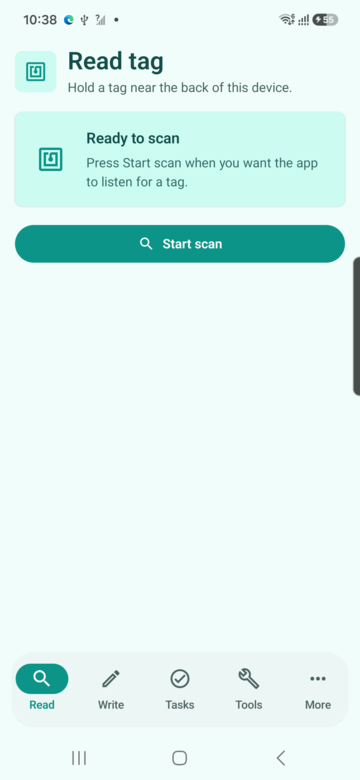
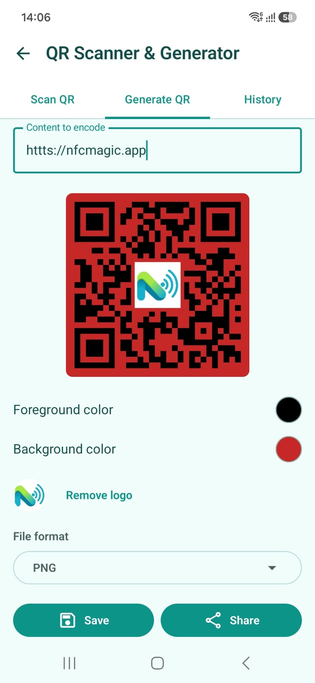
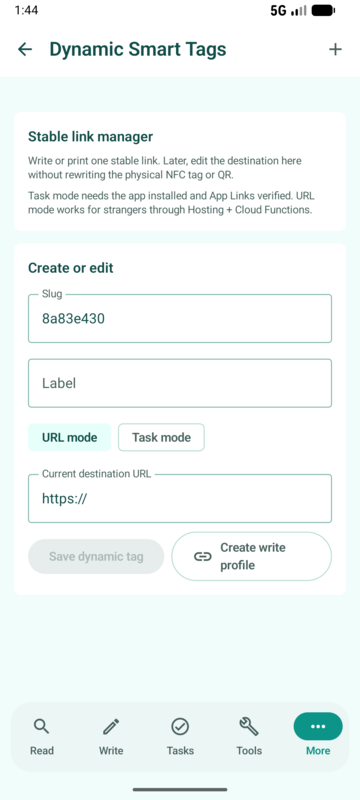
These screenshots connect this NFC vs QR code guide to the related Android workflow in NFCMagic. They show the matching screens in the NFCMagic Android app.
Frequently asked questions
Is NFC better than QR code?
Neither is universally better: NFC reduces interaction friction, while QR offers broader camera compatibility and lower physical cost.
Is NFC automatically more secure than QR?
No. Ordinary NFC and QR can both carry untrusted links; security depends on the destination, authentication and deployment controls.
Can NFC and QR point to the same page?
Yes. A stable HTTPS resolver can be encoded into both so the owner manages one destination and two physical entry channels.
Which survives damage better?
It depends on the damage: QR tolerates bounded visual loss through error correction, while NFC avoids line-of-sight but can fail from metal, liquid or antenna damage.
Primary technical sources
- Android Developers: NFC overview — Official overview of Android reader/writer mode, card emulation and tag discovery.
- NFC Forum specifications — Primary index for NDEF, record types and interoperable NFC Forum tag behavior.
- DENSO WAVE: History of QR Code — Primary history of QR Code development for automotive production in 1994.
- DENSO WAVE: QR Code standardisation — QR versions, data capacity, error-correction levels and ISO/IEC 18004 standardisation.
- DENSO WAVE: QR error correction — Primary explanation of Reed-Solomon restoration and Levels L, M, Q and H.
- Android Developers: About App Links — Verified HTTPS routing from physical labels into an installed Android application.