Direct answer
Design end-to-end NFC product authentication with threat modelling, secure tags, protected provisioning, backend verification, replay controls and trustworthy results.
Begin with the counterfeiter and the business decision
Authentication architecture starts by defining what attackers can copy, move, intercept or purchase and what decision the result must support. A consumer check, distributor intake and factory audit face different evidence, latency and remediation needs.
- Threat classes
- Separate URL copying, chip substitution, genuine-tag relocation, replay, insider key theft and backend abuse.
- Decision
- Define whether the system informs, blocks, quarantines or escalates; a green screen without an operational action is not a complete control.
Choose identifier or cryptographic proof deliberately
A static serial supports lookup and logistics but can be copied. A secure tag produces evidence under a protected key, allowing the verifier to distinguish a registered identifier from a valid cryptographic interaction.
- Low-risk
- A unique dynamic destination can be sufficient for engagement and basic asset management when adversarial copying is not the problem.
- High-risk
- Use secure IC capabilities and backend validation when the business promises anti-counterfeit or tamper-aware decisions.
Compare secure tag platforms
NTAG 424 DNA, secure MIFARE products and other vendor families differ in protocol, memory, certification, dynamic messaging, tamper options and supply availability. Select from the threat model and verifier ecosystem, not a marketing label alone.
- Interoperability
- Confirm that ordinary target phones can reach the intended NDEF or application path without proprietary reader hardware.
- Lifecycle
- Ask how keys are injected, rotated, recovered and destroyed before choosing the chip.
Protect factory provisioning
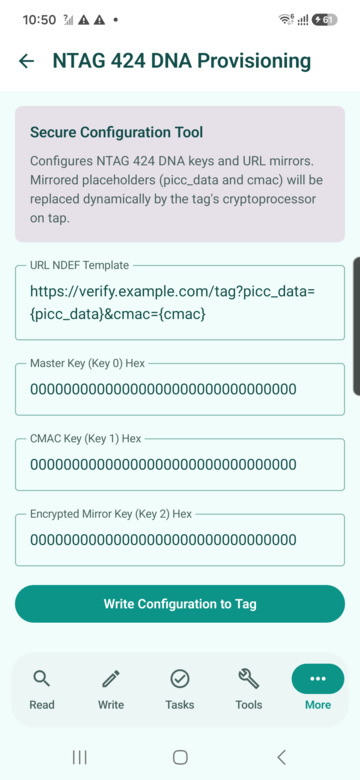
Provisioning is where blank secure ICs receive product identity, keys, files and URL templates. A controlled station authenticates the operator, receives protected job material, configures one tag and verifies it before releasing the item.
- Diversification
- Derive per-tag keys inside a trusted service or hardware boundary so one leaked tag does not expose an entire product line.
- Reconciliation
- Every accepted physical item must map to one backend record; duplicate, missing and quarantined references need explicit closure.
Build a least-privilege key hierarchy
Separate root, diversification, provisioning and verification duties. Mobile clients and public web servers should never contain master keys, and administrators should not retrieve plaintext secrets merely to operate a dashboard.
- Storage
- Use HSM, managed KMS or an approved protected boundary for production masters and record every authorized key operation.
- Rotation
- Version keys and design the database to verify existing products during a controlled migration without universal fallback secrets.
Model the verification backend
The resolver accepts bounded dynamic values, locates the product and key version, verifies cryptographic evidence, applies counter and status policy, then returns a minimal user-facing verdict. Internal reason codes remain available to authorized investigation tools.
- Input defense
- Reject unknown fields, oversized values, invalid encodings and unsupported algorithms before any expensive key operation.
- Enumeration
- Do not reveal whether arbitrary identifiers exist through distinguishable timing or verbose public errors.
Detect replay and abnormal scan patterns
Counters and recent-event state help identify one captured valid message presented repeatedly. Policy must account for retries and distributed traffic so it flags implausible sequences without punishing ordinary double taps.
- Risk signals
- Combine verified counter progress, product status, channel, coarse time and known supply-chain stage only when each signal has a documented purpose.
- Rate control
- Limit abusive traffic per resolver and tag reference while preserving a support route for legitimate high-volume checks.
Design honest verification results
Authentic, suspicious, tampered, unknown and unavailable are different. The page should explain what was checked, avoid absolute product guarantees and tell the user what to do when the outcome is not normal.
- No false counterfeit
- Network outage or malformed input belongs in unavailable or could-not-verify, not counterfeit.
- Remediation
- Provide a brand-controlled contact, batch reference or retailer guidance without asking users to publish security parameters.
Control privacy and analytics
Product verification can function without identifying the consumer. Collect only events needed for authenticity, fraud investigation and declared product analytics, and keep precise location opt-in and separate.
- Pseudonymous by default
- Treat tag and product identifiers as product data and avoid joining them to advertising profiles or unrelated customer accounts.
- Retention
- Keep raw verification events only as long as operational risk analysis requires, then aggregate or delete them.
Prepare for compromise and product retirement
Architecture needs revocation, key compromise response, counterfeit investigation and end-of-life behavior before launch. A static green result that cannot be withdrawn is dangerous after a batch is stolen or a key is exposed.
- Incident playbook
- Define who can suspend a batch, rotate verifier keys, preserve evidence and communicate with distributors.
- Long-lived URL
- After retirement, preserve a controlled informational page rather than letting the authentication domain expire or redirect elsewhere.
Quick reference
| Component | Primary trust | Failure to plan |
|---|---|---|
| Secure tag | Protected key operation | Static copy remains convincing |
| Provisioning | Correct unique configuration | Duplicate or exposed credentials |
| Backend | Verified evidence plus policy | Replay or oracle behavior |
| Result UX | Accurate bounded explanation | False confidence or panic |
Related NFCMagic app screens
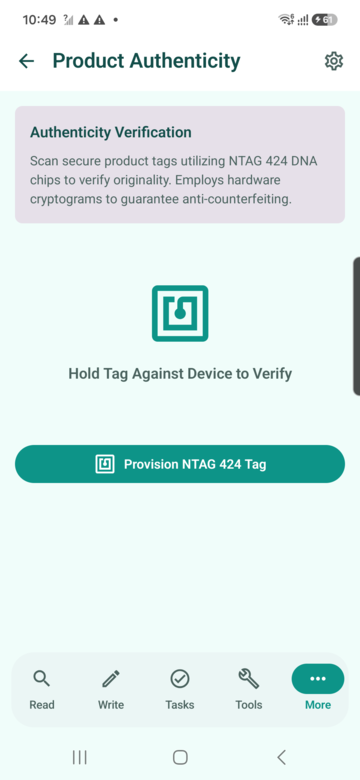
These screenshots connect this NFC product authentication architecture guide to the related Android workflow in NFCMagic. They document interface states; radio behavior still requires a physical Android device and real tags.
Frequently asked questions
Is a unique NFC UID enough for anti-counterfeit protection?
No. A visible identifier can be copied or relayed. Stronger designs verify evidence produced under a protected key.
Where should production NFC keys be stored?
Use an approved HSM, KMS or protected provisioning boundary; never place master keys in public clients or source code.
Should a network error show counterfeit?
No. Unavailable verification and failed cryptographic proof are distinct outcomes and require different user guidance.
Can a genuine tag be moved to fake packaging?
Yes. Secure attachment, tamper design and supply-chain controls address relocation beyond chip authentication.
Primary technical sources
- NXP: NTAG 424 DNA data sheet — Primary product specification for the secure NFC Forum Type 4 Tag IC.
- NXP AN12196: NTAG 424 DNA features and hints — Implementation guidance for Secure Dynamic Messaging, keys and session MACs.
- Android Developers: Android Keystore — Official key-storage model and hardware-backed protection guidance.
- NXP: MIFARE DESFire family — Official overview of secure multi-application contactless ICs and cryptography.