Direct answer
Compare NTAG213, NTAG215 and NTAG216 user memory, NDEF capacity, antenna and material choices, security features, sourcing and real-world use cases.
The NTAG21x family and its manufacturer
NXP developed NTAG213, NTAG215 and NTAG216 as NFC Forum Type 2 Tag compliant ICs for mass-market labels and connected products. They share the 13.56 MHz ISO 14443 Type A interface but allocate different amounts of user memory.
- Common foundation
- All three support NDEF configurations, a manufacturer-programmed seven-byte UID, locking, an originality signature and compatible password features.
- Do not buy by number alone
- The IC name does not describe antenna size, adhesive, face material, ferrite layer or conversion quality.
Compare usable memory, not package memory
NXP lists 144 bytes of freely available user memory for NTAG213, 504 bytes for NTAG215 and 888 bytes for NTAG216. Total physical memory is larger because capability, lock and configuration pages sit outside the ordinary NDEF payload area.
- NTAG213
- Best for compact URLs, short text and simple identifiers when the serialized message comfortably fits 144 user bytes.
- NTAG215 and 216
- Useful when vCard, multi-record or application payloads require more headroom, with NTAG216 providing the largest space of the three.
Budget the exact NDEF payload
Count the serialized message, not visible characters. Record headers, URI prefix byte, language metadata, MIME type and multiple-record overhead can make a payload exceed the selected chip even when a form looks short.
- Prototype
- Encode the final production content and read its byte length before specifying millions of labels.
- Headroom
- Reserve space for realistic destination growth or choose a short dynamic URL whose physical payload does not change.
Match each chip to common use cases
A short HTTPS link, asset identifier or feedback URL generally favors NTAG213. Larger contact data, several records or proprietary payloads may justify NTAG215 or NTAG216, but a web destination is often more maintainable than storing extensive text offline.
- Business cards
- A dynamic profile URL fits a smaller chip and remains updateable; a full offline vCard may require more memory and still becomes stale.
- Product labels
- Use capacity, physical construction and expected lifetime together; secure authenticity may require NTAG 424 DNA rather than simply more NTAG21x memory.
Antenna size controls field performance
The same IC can be connected to round, rectangular, compact or custom antennas. Larger antennas often provide a more forgiving coupling area, while tiny form factors need careful phone positioning and may perform poorly behind thick material.
- Tune in context
- Evaluate the converted label on the final object with final adhesive, laminate and printing rather than as a dry inlay.
- Phone diversity
- Test several antenna locations and device sizes; a tag optimized around one handset may frustrate the broader audience.
Design for metal, liquid and curved surfaces
Ordinary inlays can detune when mounted directly on metal, while liquid-filled packaging can reduce the field. On-metal constructions add a ferrite or spacer layer, and curved products can deform the antenna or shift the effective tap zone.
- Sample construction
- Order finished on-metal or wet-inlay samples rather than assuming a generic sticker plus foam will remain tuned.
- Placement mark
- Print the NFC symbol over the real antenna position and preserve that alignment during die cutting and lamination.
Understand lock, password and counter features
NTAG21x supports permanent lock controls, a configurable 32-bit password with PACK, an NFC counter and an ECC originality signature. These capabilities serve operational needs but do not turn the label into an AES-authenticated secure credential.
- Password scope
- Use it to limit casual reads or writes according to the data sheet, and protect configuration values from logs and exported profiles.
- Originality scope
- A supported signature can help identify an NXP IC; it does not prove that the surrounding product is authentic.
How chips become finished NFC labels
NXP supplies the IC, while antenna and inlay manufacturers attach it to an etched or printed antenna. Converters then add substrate, adhesive, facestock, printing, encoding and quality control before a label reaches the buyer.
- Yield
- Bond quality, antenna damage and die-cut alignment influence production yield even when every chip order is genuine.
- Traceability
- Ask suppliers for IC, inlay model, antenna dimensions, material stack, reel format and quality test evidence.
Run a pre-purchase qualification batch
A pilot should include finished artwork, expected payload, target object and representative phones. Measure successful first-tap rate, write verification, read distance window and failure after bending, abrasion or environmental exposure relevant to the product.
- Acceptance criteria
- Define the minimum first-pass write yield and read experience before price negotiation turns a weak inlay into the locked production choice.
- Retained samples
- Keep labelled reference tags from approved lots so later quality investigations can compare chip, antenna and encoded data.
Quick reference
| IC | User memory | Typical starting point |
|---|---|---|
| NTAG213 | 144 bytes | Short URL, identifier or simple text |
| NTAG215 | 504 bytes | Medium multi-record or contact payload |
| NTAG216 | 888 bytes | Larger offline NDEF payload |
| NTAG 424 DNA | Different secure Type 4 design | Cryptographic product authentication |
Related NFCMagic app screens
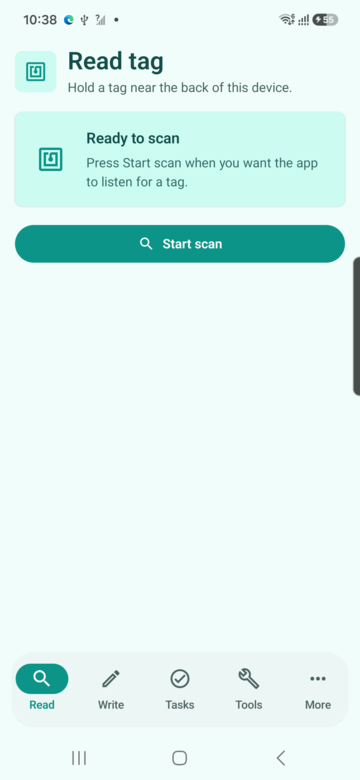
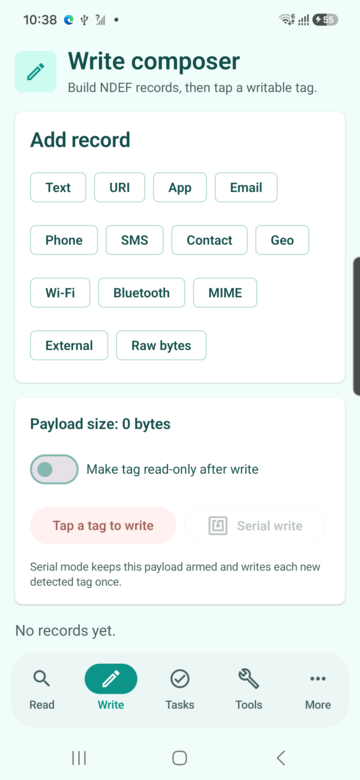
These screenshots connect this NTAG213 vs NTAG215 vs NTAG216 guide to the related Android workflow in NFCMagic. They document interface states; radio behavior still requires a physical Android device and real tags.
Frequently asked questions
How much user memory does NTAG213 have?
NXP specifies 144 bytes of freely available user read/write memory, before considering the exact NDEF message overhead.
Is NTAG216 always better than NTAG213?
No. It offers more memory but may cost more, and the finished antenna and material often matter more than unused capacity.
Can NTAG21x securely prove product authenticity?
It offers locking, password and originality features, but high-assurance per-tap cryptographic authentication calls for a secure design such as NTAG 424 DNA plus a backend.
Why does an NTAG sticker fail on metal?
Metal detunes an ordinary antenna. Use a qualified on-metal construction and test it on the final product.
Primary technical sources
- NXP: NTAG 213, 215 and 216 — Official capacities, RF characteristics, lock features and target applications.
- NFC Forum specifications — Primary index for NDEF, record types and NFC Forum tag specifications.
- Android Developers: Ndef API — API contract for capacity, writability, NDEF I/O and permanent read-only operations.