Direct answer
What is NFC? Understand its meaning, 13.56 MHz close-range operation, passive tags, NDEF records, phone modes, common uses and security limits.
NFC meaning in one sentence
NFC means Near Field Communication: a standards-based, close-range contactless technology that lets compatible devices and tags exchange small amounts of data through a 13.56 MHz radio field. A typical interaction is deliberate and local—a phone is brought close to a label, terminal or another supported device.
- Near field
- The short operating zone is part of the interaction design, but proximity alone is not authentication or permission.
- Communication
- Depending on the mode, an NFC device can read a tag, emulate a contactless card or communicate with another NFC device.
What an NFC tag is
An NFC tag is usually a small integrated circuit connected to a tuned antenna and embedded in a sticker, card, keychain or product. Many consumer tags are passive: the reader's field supplies the energy needed to answer. The tag can store standardized NDEF records or technology-specific data and configuration.
- No battery required
- Passive operation makes labels thin and inexpensive, but read quality still depends on antenna geometry, materials and alignment.
- Not every tag is writable
- A tag can be factory locked, permanently locked after programming, password protected, damaged or mapped to a non-NDEF application.
How an NFC tap works
The phone creates a magnetic field, the nearby tag antenna couples to it, and the chip powers up long enough to exchange protocol frames. Anti-collision selects a target when more than one compatible tag responds. The system or app then interprets the returned bytes as NDEF or through a technology-specific protocol.
- Orientation matters
- Coupling is usually strongest when the phone and tag antenna planes are roughly parallel and close without a metal barrier.
- Fresh interaction
- When a tag leaves and returns, the operating system creates a new discovery event; apps should not reuse a stale connection.
What NDEF means
NDEF is the NFC Data Exchange Format, a compact message structure standardized for interoperable content. An NDEF message can hold records for a website, plain text, contact data or other registered types. NDEF describes how data is packaged; it does not automatically encrypt the payload or prove who wrote it.
- Portable data
- A valid HTTPS URI record is widely useful because phones can route it without knowing the chip's raw page layout.
- Capacity overhead
- Headers, type fields and container metadata consume bytes, so advertised memory and usable payload length are not identical.
The five NFC Forum tag types
The NFC Forum defines tag types so devices can discover and read NDEF through different underlying protocols. The type is an interoperability category, not a quality grade or physical shape. Common Type 2 labels, Type 4 secure products and Type 5 longer-range-style HF labels can all carry NDEF with different capabilities.
- Same outcome, different transport
- A reader ultimately obtains NDEF records, while command sets, capacity, speed and optional security differ underneath.
- Current standards
- Specification releases evolve; teams should rely on the current NFC Forum and manufacturer documents rather than an old comparison chart.
NFC modes in a phone
Reader/writer mode lets a phone interrogate tags. Card emulation lets supported phone services present a contactless application to a reader. Peer-oriented exchanges exist within the broader standards history, while modern consumer experiences commonly center on tag reading, payments and controlled device interactions. Each mode has its own APIs and security model.
- Reader is not payment
- Reading an NDEF sticker does not expose the protected keys used by payment cards or secure access credentials.
- Hardware is essential
- An application cannot add NFC to a phone that lacks the controller and antenna required for the radio link.
Common NFC tag uses
Useful tags connect a physical place or object to a small, understandable action. Examples include opening product instructions, sharing a portfolio, starting a phone routine, identifying equipment, offering a restaurant menu or linking packaging to an authenticity service. The best experiences make the reason for tapping visible before the interaction.
- Static payload
- A tag can store the final text or URL directly when the information is unlikely to change.
- Managed destination
- A stable HTTPS resolver can keep an installed tag useful while an authorized owner updates the final destination later.
NFC cards are not all the same
A plastic card may contain a simple public NDEF inlay, a secure contactless credential, a payment application or several technologies. Shape does not reveal protocol or permissions. A phone may detect the card while remaining unable—and unauthorized—to read protected application data or reproduce secret-backed behavior.
- UID limitation
- A visible identifier is not equivalent to the credential keys and transaction logic protected inside a secure card.
- Responsible boundary
- Copying public NDEF content is legitimate; cloning payment, transit, passport or protected access credentials is a different and restricted problem.
NFC safety and privacy
The close range reduces accidental interaction but does not make every payload trustworthy. A public tag can point to a misleading website, and a legitimate tag can be replaced. Users should preview unfamiliar destinations, avoid entering sensitive information after an unexpected tap and treat security claims as properties of the whole system.
- Tag security
- Passwords and lock bits control some memory operations but do not turn a plain URL into cryptographic product authentication.
- System security
- High-assurance verification needs appropriate secure silicon, protected keys, replay handling and a trustworthy backend result.
How to start with NFC
Begin with a known, writable NFC Forum tag, a physical NFC-capable phone and a simple HTTPS NDEF record. Read the tag first, write a short test destination, read it again and test another phone. Only then decide whether you need automation, dynamic routing, batch operations, stronger materials or secure authentication.
- Small pilot
- A handful of samples reveals antenna, adhesive and phone-compatibility problems before a large purchase or print run.
- Document evidence
- Record chip family, payload bytes, device model, operating system and installed surface so failures can be reproduced.
Quick reference
| Term | Meaning | Important limit |
|---|---|---|
| NFC | Near Field Communication | Requires compatible hardware |
| NFC tag | Chip plus tuned antenna | May be locked or non-NDEF |
| NDEF | Interoperable message format | Not encryption |
| UID | Chip identifier | Not a secret credential |
Related NFCMagic app screens
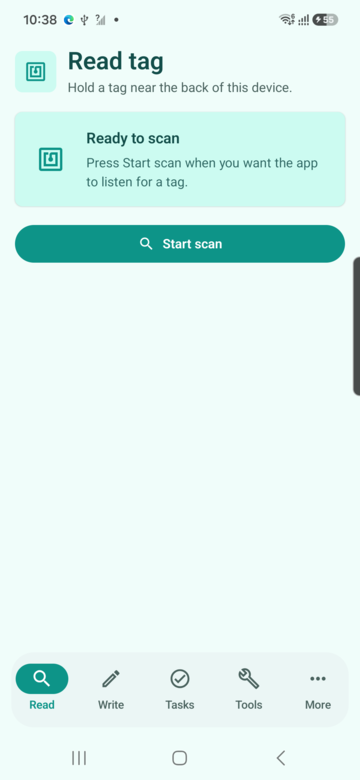
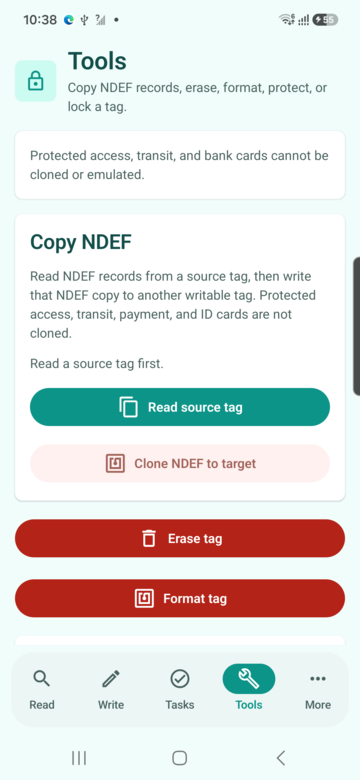
These screenshots connect this what is nfc guide to the related Android workflow in NFCMagic. They document interface states; radio behavior still requires a physical Android device and real tags.
Frequently asked questions
What does NFC stand for?
NFC stands for Near Field Communication, a close-range contactless communication technology.
Does an NFC tag need a battery?
Most consumer NFC labels are passive and receive operating energy from the reader's radio field.
Is NFC the same as Bluetooth?
No. NFC uses a much closer intentional interaction and different protocols; Bluetooth commonly maintains longer-range powered connections.
Can every NFC tag be rewritten?
No. Tags can be locked, protected, damaged, unsupported or designed for another application.
Primary technical sources
- NFC Forum: NFC technology — Standards-body overview of 13.56 MHz NFC, NDEF and the five NFC Forum tag types.
- NFC Forum specifications — Primary specification index for NDEF, record types and interoperable NFC tag behavior.
- Android Developers: NFC overview — Official overview of Android NFC, NDEF messages and raw tag technology access.
- Apple Developer: Core NFC — Official iPhone framework documentation for reading NDEF and protocol-specific tags and writing compatible tags.