Direct answer
Compare NFC Forum tag types and NTAG213, NTAG215 and NTAG216 by protocol, user memory, security, phone compatibility and practical deployment needs.
Tag type is a protocol category
NFC Forum tag types describe interoperable operation and NDEF mapping, not sticker shape or seller quality. Type, chip family, antenna and finished material answer different questions. In this nfc tag types guide, the distinction is treated as a deployment decision rather than a marketing shortcut: verify the physical sample, encoded payload, phone behavior and user-facing result together before scaling.
- Interoperability
- A compliant device can obtain NDEF through different underlying tag protocols.
- Purchase warning
- Artwork saying NFC does not identify the IC, capacity or lock configuration.
- Decision point
- For NFC Tag Types: NTAG213, NTAG215 and NTAG216, section 1 turns the search question into a testable choice with a visible result, a failure path and evidence that another operator can reproduce.
Type 1 through Type 5
The five types cover different protocol foundations, performance profiles and product histories. Current projects commonly encounter Type 2, Type 4 and Type 5 in labels and connected products. In this nfc tag types guide, the distinction is treated as a deployment decision rather than a marketing shortcut: verify the physical sample, encoded payload, phone behavior and user-facing result together before scaling.
- Type 2
- Compact ISO 14443 Type A labels are common for URLs and simple records.
- Type 4 and 5
- Type 4 supports file-oriented ISO-DEP designs; Type 5 uses an ISO 15693 foundation.
- Decision point
- For NFC Tag Types: NTAG213, NTAG215 and NTAG216, section 2 turns the search question into a testable choice with a visible result, a failure path and evidence that another operator can reproduce.
Why NTAG21x is common
NXP designed NTAG213, NTAG215 and NTAG216 as NFC Forum Type 2 compliant ICs for mass-market labels, media, electronics and companion tags. In this nfc tag types guide, the distinction is treated as a deployment decision rather than a marketing shortcut: verify the physical sample, encoded payload, phone behavior and user-facing result together before scaling.
- Shared base
- They use ISO 14443 Type A, a seven-byte UID and compatible NDEF configurations.
- Different memory
- Their main purchasing distinction is 144, 504 or 888 bytes of user read/write memory.
- Decision point
- For NFC Tag Types: NTAG213, NTAG215 and NTAG216, section 3 turns the search question into a testable choice with a visible result, a failure path and evidence that another operator can reproduce.
NTAG213 for short payloads
NTAG213 is often sufficient for one concise HTTPS record and is attractive when price and label size matter. Capacity must be checked against encoded NDEF bytes. In this nfc tag types guide, the distinction is treated as a deployment decision rather than a marketing shortcut: verify the physical sample, encoded payload, phone behavior and user-facing result together before scaling.
- User memory
- NXP specifies 144 bytes of freely available user memory.
- Good fit
- Short managed URLs, identifiers and simple automation cues usually avoid wasted capacity.
- Decision point
- For NFC Tag Types: NTAG213, NTAG215 and NTAG216, section 4 turns the search question into a testable choice with a visible result, a failure path and evidence that another operator can reproduce.
NTAG215 for middle capacity
NTAG215 provides a larger working area without automatically becoming the best tag for every deployment. It is useful when a measured message exceeds NTAG213. In this nfc tag types guide, the distinction is treated as a deployment decision rather than a marketing shortcut: verify the physical sample, encoded payload, phone behavior and user-facing result together before scaling.
- User memory
- NXP specifies 504 bytes of user read/write memory.
- Selection rule
- Choose it for actual payload need, not because a marketplace listing calls it premium.
- Decision point
- For NFC Tag Types: NTAG213, NTAG215 and NTAG216, section 5 turns the search question into a testable choice with a visible result, a failure path and evidence that another operator can reproduce.
NTAG216 for longer NDEF
NTAG216 supplies the largest NTAG21x user area and can hold longer or multiple records. More unused memory does not fix weak antennas, metal detuning or poor adhesive. In this nfc tag types guide, the distinction is treated as a deployment decision rather than a marketing shortcut: verify the physical sample, encoded payload, phone behavior and user-facing result together before scaling.
- User memory
- NXP specifies 888 bytes of user read/write memory.
- Tradeoff
- Higher capacity can cost more and remains subject to NDEF and configuration overhead.
- Decision point
- For NFC Tag Types: NTAG213, NTAG215 and NTAG216, section 6 turns the search question into a testable choice with a visible result, a failure path and evidence that another operator can reproduce.
Locks, passwords and originality
NTAG21x includes configurable password features, locking and an originality signature. These controls are useful but should not be described as equivalent to secure dynamic cryptographic authentication. In this nfc tag types guide, the distinction is treated as a deployment decision rather than a marketing shortcut: verify the physical sample, encoded payload, phone behavior and user-facing result together before scaling.
- Irreversible state
- Read-only locks can permanently prevent later correction.
- System security
- High-assurance authenticity needs secure provisioning, protected keys and backend verification.
- Decision point
- For NFC Tag Types: NTAG213, NTAG215 and NTAG216, section 7 turns the search question into a testable choice with a visible result, a failure path and evidence that another operator can reproduce.
Antenna and material selection
The chip is only one component. Antenna dimensions, ferrite, substrate, adhesive, printing, bending and installation surface often determine whether a phone reads reliably. In this nfc tag types guide, the distinction is treated as a deployment decision rather than a marketing shortcut: verify the physical sample, encoded payload, phone behavior and user-facing result together before scaling.
- Metal
- Ordinary inlays detune on metal; use a qualified on-metal construction.
- Small labels
- A compact antenna may reduce coupling margin even when memory capacity is generous.
- Decision point
- For NFC Tag Types: NTAG213, NTAG215 and NTAG216, section 8 turns the search question into a testable choice with a visible result, a failure path and evidence that another operator can reproduce.
Phone compatibility
Standard NDEF on a suitable tag offers broad compatibility, while raw commands and proprietary configurations narrow the device set. Test final products on representative Android and iPhone models. In this nfc tag types guide, the distinction is treated as a deployment decision rather than a marketing shortcut: verify the physical sample, encoded payload, phone behavior and user-facing result together before scaling.
- Payload first
- Use standard URI records when a universal phone experience is the goal.
- Physical evidence
- A browser or emulator cannot validate RF behavior or antenna placement.
- Decision point
- For NFC Tag Types: NTAG213, NTAG215 and NTAG216, section 9 turns the search question into a testable choice with a visible result, a failure path and evidence that another operator can reproduce.
Procurement checklist
Request exact IC, antenna dimensions, construction, adhesive, environmental ratings and samples. Inspect delivered tags with an app before approving a large batch. In this nfc tag types guide, the distinction is treated as a deployment decision rather than a marketing shortcut: verify the physical sample, encoded payload, phone behavior and user-facing result together before scaling.
- Incoming inspection
- Compare technology, capacity, write state and sample read performance with the purchase specification.
- Pilot
- Write, install and retest tags on the real product before production release.
- Decision point
- For NFC Tag Types: NTAG213, NTAG215 and NTAG216, section 10 turns the search question into a testable choice with a visible result, a failure path and evidence that another operator can reproduce.
Quick reference
| Chip | User memory | Typical decision |
|---|---|---|
| NTAG213 | 144 bytes | Short URL |
| NTAG215 | 504 bytes | Medium payload |
| NTAG216 | 888 bytes | Longer/multiple records |
| Other types | Varies | Protocol or security need |
Related NFCMagic app screens
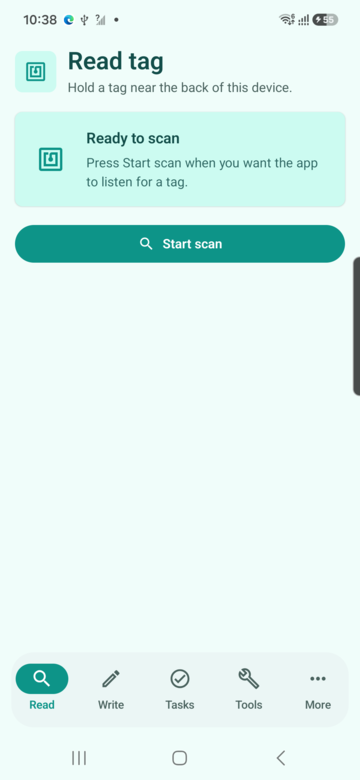
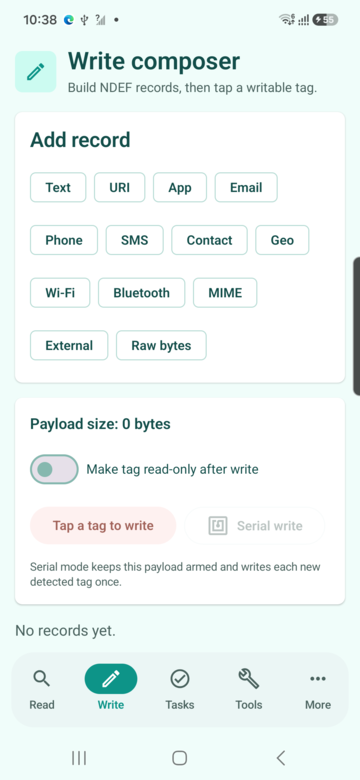
These screenshots connect this nfc tag types guide to the related Android workflow in NFCMagic. They document interface states; radio behavior still requires a physical Android device and real tags.
Frequently asked questions
Which NFC tag type works with phones?
Use an NFC Forum compatible tag and standard NDEF content, then test the exact phone and finished label.
Is NTAG216 always better?
No. It adds memory but may add cost, while antenna and material often matter more.
Can NTAG213 hold a website?
Usually yes for a short HTTPS record, subject to exact encoded length.
Are chip and sticker type the same?
No. The IC, antenna and physical conversion are separate specifications.
Primary technical sources
- NFC Forum: NFC technology — Standards-body overview of 13.56 MHz NFC, NDEF and the five NFC Forum tag types.
- NFC Forum specifications — Primary specification index for NDEF, record types and interoperable NFC tag behavior.
- NXP: NTAG213, NTAG215 and NTAG216 — Manufacturer source for Type 2 compliance, 144/504/888-byte user memory and chip features.
- NXP: NTAG tags and labels — Manufacturer portfolio showing capacity, endurance and security differences among label IC families.