Direct answer
Create professional NFC business cards with the right chip, antenna and material, vCard or dynamic profile, QR fallback, accessible landing page and production testing.
From printed cards to tap-and-scan profiles
A professional NFC card extends the familiar exchange of contact details with a tap, while QR provides a visible camera route. The goal is not to showcase the chip; it is to let the recipient save or use the correct contact information with minimal friction.
- Paper remains useful
- Printed name, role and human-readable contact stay available when the phone has no NFC, the card is damaged or the recipient prefers not to scan.
- Clear instruction
- Mark the antenna location and say Tap or scan to save contact rather than expecting users to discover an invisible interaction.
Choose between an offline vCard and a profile URL
A vCard NDEF record can carry contact data directly, but field support and payload size vary. A short HTTPS profile is smaller, updateable and can present several actions, though it depends on a durable web service.
- Offline vCard
- Useful for stable core fields when the chosen receiving phones handle the MIME record consistently.
- Dynamic profile
- Better when title, portfolio, social links or campaign details change after printing.
Select a chip from the encoded payload
A short profile URL often fits NTAG213, while a full vCard or multi-record message may need NTAG215 or NTAG216. Serialize the final record set and leave headroom before approving the card bill of materials.
- No overbuying
- Unused memory does not improve tap distance; antenna and material integration control RF performance.
- Security boundary
- Ordinary business-card NDEF is public and copyable. Use a secure design only when product identity, not contact sharing, needs cryptographic proof.
Engineer the antenna and card material
PVC, paper, wood and composite cards can embed ordinary inlays, but metal blocks or detunes a conventional antenna. Metal cards need an engineered window, spacer or ferrite-backed on-metal construction.
- Real assembly
- Test the chip after lamination, printing and edge finishing because heat, pressure and cutting can damage the inlay.
- Tap target
- Keep the printed NFC mark aligned with the actual antenna and away from magnetic stripes, foil or metal hardware.
Understand the manufacturing chain
The semiconductor vendor supplies the IC, an inlay maker bonds it to an antenna, and a card converter laminates, prints, cuts and optionally encodes the finished product. Quality questions should identify each layer rather than asking only whether the card contains NFC.
- Supplier brief
- Specify chip, antenna size, material stack, print process, encoding state, reel or sheet handling and acceptance yield.
- Pre-encoding
- If the converter writes cards, provide a versioned profile and require a machine-readable result mapping plus sample verification.
Add a QR fallback without visual clutter
The QR code should resolve to the same canonical profile as NFC and retain adequate size, contrast and quiet zone. Place it where hands and card holders will not cover it during scanning.
- One identity
- Use one controlled domain and consistent profile rather than giving tap and scan recipients different contact versions.
- Print proof
- Scan the final coated card under office, event and low-light conditions across several cameras.
Build an accessible, fast profile page
The landing page should load quickly on mobile, identify the person and organization, expose Save contact and preferred communication actions, and remain usable with large text, keyboard and screen reader.
- Consent
- Do not trigger a call, message, calendar event or app install automatically when the profile opens.
- Privacy
- Publish only contact fields the card owner intends to make public and provide a way to retire a lost card.
Keep the profile updateable and trustworthy
A dynamic destination lets the owner change role, company or portfolio without discarding cards. Protect edits with authentication, retain change history and show the trusted domain so recipients can recognize the source.
- Lost card
- Pause the resolver or replace the public profile without allowing an old card slug to be reassigned to another person.
- Ownership transfer
- Organizations need an offboarding process that removes company data while respecting the individual's card and account agreements.
Measure useful outcomes
A tap count alone does not show whether the recipient saved a contact or started a conversation. Measure privacy-respecting page actions such as Save contact or Portfolio view only when the card owner understands the reporting.
- Channel
- Distinguish NFC and QR entry at the resolver without embedding personal recipient identifiers.
- No surveillance
- Do not turn a professional introduction into hidden precise-location or device fingerprint tracking.
Qualify the finished card before ordering volume
Write and verify production samples, tap them from both sides, test the intended phone range and inspect performance in wallets or card holders. Repeat after environmental and abrasion exposure appropriate to the sales promise.
- Acceptance
- Set first-tap success, QR readability, visual alignment and encoded-content requirements in the purchase order.
- Support
- Print or publish a short instruction for recipients who do not know where their phone antenna is located.
Quick reference
| Design choice | Advantage | Trade-off |
|---|---|---|
| Offline vCard | Direct contact payload | Harder to update and larger |
| Profile URL | Small and updateable | Needs durable hosting |
| PVC or paper | Simple antenna integration | Material wear varies |
| Metal card | Premium finish | Requires engineered RF isolation |
Related NFCMagic app screens
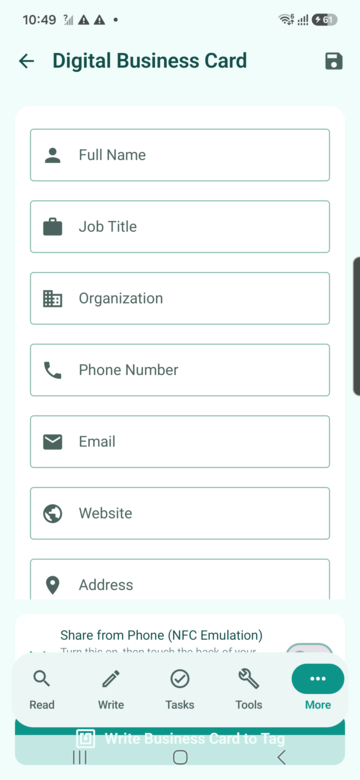
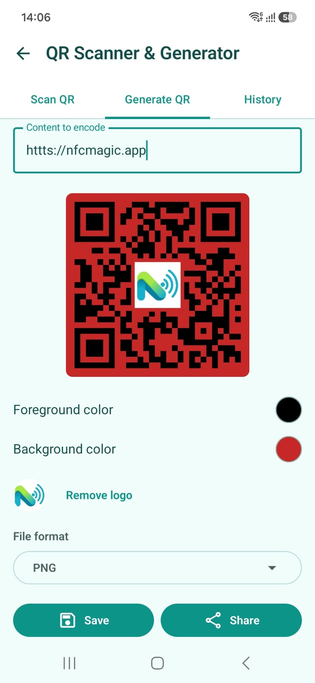
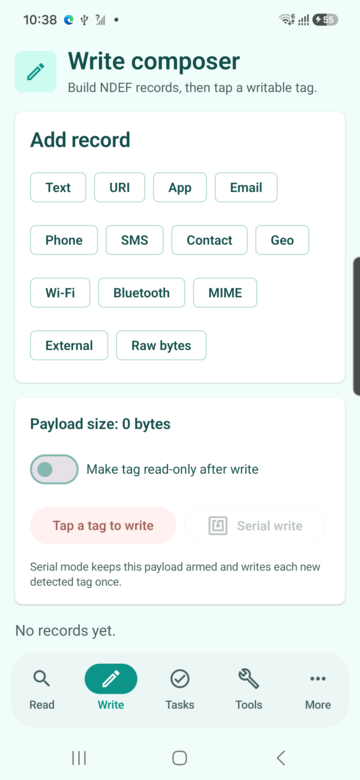
These screenshots connect this professional NFC business cards guide to the related Android workflow in NFCMagic. They document interface states; radio behavior still requires a physical Android device and real tags.
Frequently asked questions
Which NFC chip is best for a business card?
Choose from the serialized payload and card construction. A short profile URL often fits NTAG213; larger offline contact records may need more memory.
Do metal NFC business cards work?
They can, but require an engineered antenna window, spacer or ferrite-backed on-metal construction and final-assembly testing.
Can contact details be changed after printing?
Yes when the card stores a stable profile URL. A fixed offline vCard must be rewritten if it remains writable.
Are NFC business cards copy-protected?
Ordinary public NDEF is copyable. Do not promise cryptographic copy protection without a secure tag and verification architecture.
Primary technical sources
- NXP: NTAG 213, 215 and 216 — Official capacities, RF characteristics, lock features and target applications.
- DENSO WAVE: QR Code standardisation — QR versions, capacity, error-correction levels and international standards.
- W3C: Web Content Accessibility Guidelines 2.2 — Normative accessibility requirements for web content and text alternatives.