Direct answer
Plan reliable NFC batch writing with versioned profiles, serialization, operator stations, verify-after-write, reject handling, audit logs and supplier quality control.
Turn a write screen into a controlled production process
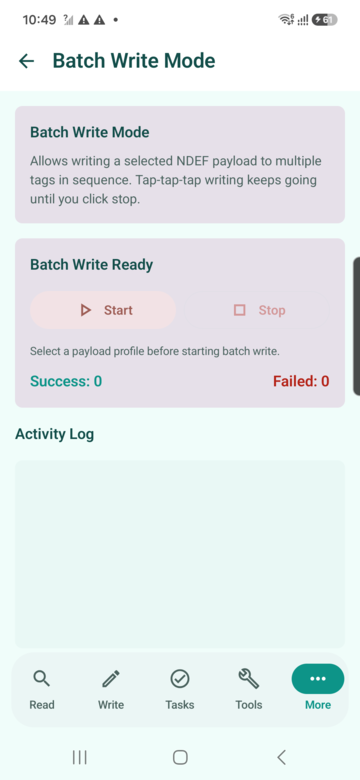
Batch writing is not merely leaving the writer armed for repeated taps. Operations teams need a work order, approved payload version, qualified tag stock, physical station layout, verification rule and a clear end-of-batch record.
- Work order
- Identify product, quantity, profile version, expected chip or inlay, operator and acceptance criteria before the first target is presented.
- Stop condition
- Define when the station must pause, such as repeated verification failures, an unexpected tag family or a profile mismatch.
Freeze and approve the payload profile
A production profile should be immutable for the active batch. Editing a destination or adding a record halfway through creates mixed inventory that looks identical after packaging and is difficult to recall.
- Version identity
- Display a human-readable revision and a content hash in the batch header and export.
- Approval sample
- Write one golden tag, re-read it independently and obtain sign-off before enabling continuous production.
Separate common and serialized data
Some jobs write one message to every tag; others inject a product ID, asset number or signed resolver. The station must distinguish shared fields from per-item fields and prevent a previous row from being reused after an error.
- Input control
- Validate CSV or API data for uniqueness, length, allowed characters and destination domain before operators touch physical stock.
- Traceability
- Bind the external product reference to the observed tag result without exposing secret keys in the exported mapping.
Design the physical encoding station
A marked presentation zone helps the operator place one tag at a time over the phone antenna. Nearby tags, metal benches, stacked inlays and cables can change RF behavior or cause the wrong target to enter the field.
- Fixture
- Use a non-metallic spacer or tested jig that aligns the intended inlay while keeping the next label outside the active field.
- Ergonomics
- Arrange blank, passed and rejected containers so the operator never returns an uncertain tag to unused stock.
Verify every encoded target
After writing, reconnect and compare the stored NDEF or secure configuration with the intended item. A batch counter should increase only when both write and verification reach the approved state.
- Two counters
- Track attempts separately from accepted items so throughput reports reveal retries and quality drift.
- Independent sampling
- Periodically read passed tags with another device or reader to detect a station-specific assumption.
Handle rejects and uncertain writes
Tag loss, insufficient capacity, unexpected locks and duplicate serial data need explicit dispositions. An uncertain tag goes to quarantine for inspection; it is not silently returned to the blank pile or counted as finished.
- Reason codes
- Record movement, read-only, capacity, wrong chip, malformed source data and verification mismatch as distinct reject classes.
- Retry policy
- Permit a bounded retry only after re-reading the target and confirming that another attempt cannot duplicate an irreversible external record.
Measure throughput honestly
Useful throughput includes presentation, discovery, write, verification, label handling and reject resolution. A fast write call is not the production rate if operators wait for ambiguous feedback or repeat taps.
- Cycle time
- Measure median and high-percentile accepted-item time instead of advertising the fastest observed tag.
- Bottleneck
- Reduce payload size, improve antenna alignment or split serialization preparation from encoding only after measurements identify the limiting step.
Audit without collecting unnecessary data
The batch record should prove which approved profile and stock produced accepted items. It usually does not need employee personal data, customer contact information or unredacted credentials.
- Minimum log
- Keep batch reference, profile revision, item reference, result, timestamp and non-secret diagnostic code according to an explicit retention policy.
- Export review
- Redact sensitive payload values and protect serialized mappings before sharing production reports outside the operations team.
Qualify reels, inlays and converted labels
Chip authenticity alone does not guarantee a usable batch. Antenna cracks, weak die bonds, adhesive contamination, incorrect reel orientation and die-cut damage can reduce yield after conversion or printing.
- Incoming inspection
- Sample each lot for technology, capacity, first-tap read, write verification and physical dimensions before releasing it to production.
- Supplier evidence
- Request IC and inlay identification, material stack, reel map and declared quality method from the converter.
Run a pilot before full volume
A representative pilot uses final stock, artwork, payload source, station and packaging. It exercises normal operation plus deliberate movement, duplicate data, a locked tag and loss of network where the workflow depends on a backend.
- Acceptance
- Set maximum reject rate, verification requirement and reconciliation rules before the pilot rather than judging the output after sunk cost.
- Release packet
- Keep the golden tag, approved profile, test report and operator instructions together for repeat orders.
Quick reference
| Count | Meaning | Must not be confused with |
|---|---|---|
| Attempted | A target entered the write flow | Finished inventory |
| Written | The write API returned success | Verified content |
| Accepted | Re-read matched the approved item | Packed quantity |
| Rejected | Target needs quarantine or disposal | Unused blank stock |
Related NFCMagic app screens
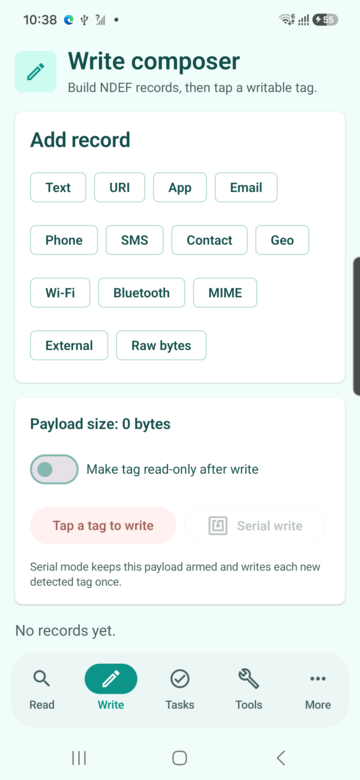
These screenshots connect this batch writing NFC tags guide to the related Android workflow in NFCMagic. They document interface states; radio behavior still requires a physical Android device and real tags.
Frequently asked questions
Should every NFC tag in a batch be verified?
For operational reliability, yes: re-read and compare the target before counting it as accepted.
Can several tags be stacked during encoding?
Nearby inlays can interfere or present the wrong target. Use a qualified fixture and keep queued stock outside the RF field.
How should failed tags be handled?
Move uncertain targets to a separate quarantine path with a reason code; never return them silently to blank stock.
What is the first step before a large run?
Write and independently verify a golden sample using the final profile, stock and installation materials.
Primary technical sources
- Android Developers: Ndef API — API contract for capacity, writability, NDEF I/O and permanent read-only operations.
- NXP: NTAG 213, 215 and 216 — Official capacities, RF characteristics, lock features and target applications.
- Android Developers: Advanced NFC — Official guidance for tag technologies, NDEF operations and foreground dispatch.