Direct answer
Learn why Android NFC apps cannot clone protected access cards, how UID differs from a credential, and where public NDEF copying legitimately applies.
A detected card is not a copied credential
Android can report that a contactless object is present and expose a Tag handle without revealing the protected application data required by a door, payment or transit system. Detection proves radio compatibility, not authorization.
- Metadata
- Technology names, historical bytes or a visible identifier may help classify the card but do not recreate its secret state.
- Product honesty
- An app should say protected or unsupported instead of implying that more tapping, root access or a generic memory tool can reproduce the credential.
UID, public memory and credentials are different layers
A UID identifies a chip during anti-collision or application logic, public memory stores readable data, and a credential proves an authorized relationship through secrets or signed state. Treating these values as interchangeable leads to false cloning claims.
- UID limits
- Some products support random identifiers, and Android HCE itself should be assumed to present a random UID between taps.
- Public NDEF
- A URL or text record can often be copied to another writable tag because it is intended to be public, but the new tag remains a different physical object.
Memory cards versus secure microcontroller cards
Simple labels expose a small memory map with optional lock or password controls. Secure cards such as MIFARE DESFire use an application and file model with cryptographic engines, access rights and authenticated communication.
- Different operations
- Reading pages from a Type 2 tag and exchanging ISO 7816-4 APDUs with a secure card are fundamentally different workflows.
- System design
- A secure deployment depends on keys, reader configuration and backend policy; possessing one card does not expose those system secrets.
Mutual authentication and secure messaging
Secure readers and cards can challenge one another, derive session state and protect subsequent commands with encryption or message authentication. A captured exchange cannot simply be replayed when counters, randomness or session keys change.
- Key boundary
- The long-term key is provisioned by the system operator and should not be readable from the credential through ordinary NFC commands.
- Reader policy
- The door or terminal decides what proof it accepts; a generic Android application cannot instruct that infrastructure to trust a replacement token.
Why reading a UID is not enough
Legacy systems sometimes used a visible serial number as an identifier, but security-sensitive designs validate cryptographic data and transaction context. A UID-only assumption is a weakness in the reader system, not a general NFC cloning capability.
- No authentication
- A serial number can label an object, but by itself it does not prove possession of a secret.
- Privacy
- Random-ID modes and application-level identifiers reduce persistent tracking based on the anti-collision identifier.
Android HCE is not a universal card copier
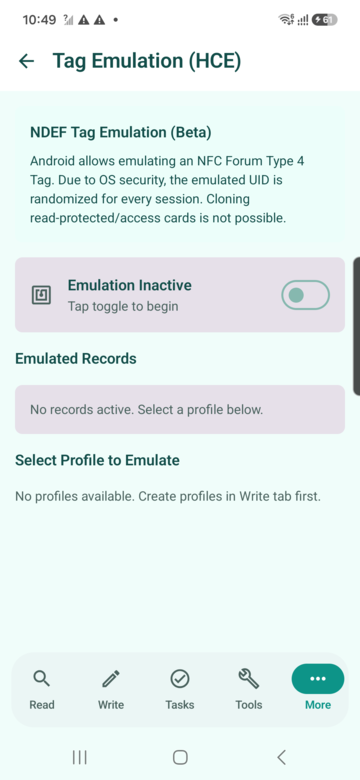
Host Card Emulation routes supported ISO-DEP APDUs to an Android service selected by AID. It does not let an app reproduce every RF technology, choose all controller parameters or guarantee the fixed UID expected by a legacy reader.
- Protocol contract
- The application must implement a protocol the reader intentionally supports; recording unknown traffic does not create that contract.
- UID behavior
- Official Android guidance says HCE readers should not use the phone's presented UID for authentication or identification because it should be treated as random.
What NFCMagic can legitimately copy
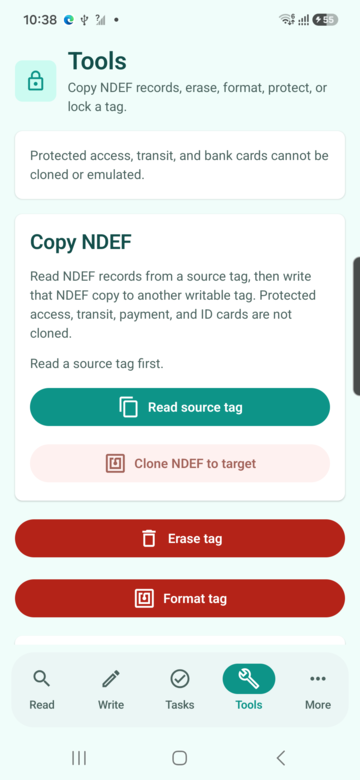
NFCMagic can read a public NDEF message from a source and write the same logical records to a separate compatible target with enough capacity. This supports replacement labels, public links, contacts and other owner-authorized content.
- Compatibility
- The destination needs a writable NDEF path and capacity for the serialized message; identical artwork does not guarantee either condition.
- Result wording
- Call the operation Copy NDEF or duplicate public content, not access-card cloning.
Legal and ethical operating boundaries
Access, payment, transit and identity credentials belong to systems with explicit owners and authorization rules. Diagnostic tools should require the operator to work only on tags and infrastructure they own or are contracted to test.
- Data minimisation
- Do not upload identifiers, dumps or APDU transcripts to analytics; retain only what the authorized troubleshooting task requires.
- Safe documentation
- Explain architecture and limitations without publishing bypass steps, extracted keys or instructions aimed at defeating a live system.
Legitimate migration paths for organizations
An organization replacing an access system should use its credential-management platform, issue new authorized mobile credentials or re-enrol users through the vendor's supported process. A phone utility is not a substitute for credential issuance.
- Mobile credentials
- Supported deployments provision trust through secure elements, wallet roles, HCE services or vendor SDKs under operator control.
- Reader upgrade
- If a legacy reader accepts only a visible UID, the durable fix is to migrate the reader and authorization policy rather than duplicate identifiers.
How to explain the limitation to users
A useful message names the boundary and offers the safe action available. For example: this card uses protected credentials; NFCMagic can identify the technology but cannot read, copy or emulate its secure access data.
- Avoid blame
- Do not describe a protected response as a broken phone or bad tag when the system is working as designed.
- Offer alternatives
- Point users toward reading public NDEF, writing a personal tag or contacting the card issuer for an authorized replacement.
Quick reference
| Observed item | What it means | What it does not prove |
|---|---|---|
| UID | An RF-layer or configured identifier | Possession of a secret credential |
| Public NDEF | Interoperable message content | Access to protected files |
| IsoDep | ISO-DEP communication is available | The app knows the card protocol or keys |
| HCE service | Android can answer supported APDUs | Universal emulation of a physical card |
Related NFCMagic app screens
These screenshots connect this why Android apps cannot clone access cards guide to the related Android workflow in NFCMagic. They document interface states; radio behavior still requires a physical Android device and real tags.
Frequently asked questions
Can an Android app copy a door card after reading its UID?
No. A UID is not the cryptographic credential used by a properly designed access system.
Why can the phone detect a bank card but not show its data?
Detection occurs before protected application access. Payment data and commands are governed by secure protocols and authorization.
Can HCE present the same fixed UID as a card?
Android guidance says HCE UIDs should be treated as random, so readers must not depend on them for authentication.
What kind of NFC content can be copied safely?
Public NDEF records such as a URL, text or contact can be copied between compatible writable tags when the owner authorizes it.
Primary technical sources
- Android Developers: Host-based card emulation — Official HCE architecture, APDU routing, AID selection and UID limitations.
- NXP: MIFARE DESFire family — Official overview of secure multi-application contactless ICs and cryptography.
- Android Developers: Advanced NFC — Official guidance for tag technologies, NDEF operations and foreground dispatch.