QR Code vs Barcode: What Is the Difference?
QR codes and traditional barcodes are both technologies designed to represent information in a machine-readable visual format.
At first glance, they perform a similar function.
A code is created.
The code is printed or displayed.
A scanner reads it.
The encoded information is then processed by a computer or smartphone.
However, QR codes and traditional one-dimensional barcodes use fundamentally different approaches to storing information.
A traditional barcode normally stores information horizontally.
A QR code stores information across both horizontal and vertical dimensions.
This fundamental difference affects capacity, physical dimensions, scanning orientation, error correction, and the types of applications each technology can support.
What Is a Traditional Barcode?
A traditional barcode consists of parallel lines and spaces of different widths.
These patterns represent numbers or other information.
The scanner analyzes the sequence and converts it into digital data.
Many different barcode standards exist.
Examples include UPC, EAN, Code 39, Code 128, and ITF.
Each format was designed for particular applications.
What Is a QR Code?
QR stands for Quick Response.
A QR code is a two-dimensional matrix barcode.
Instead of representing data primarily through a sequence of vertical bars, it uses a grid of small modules.
These modules form the familiar square qrcode pattern.
A QR code generator converts input data into this structured matrix.
A QR code reader analyzes the matrix and reconstructs the original information.
1D vs. 2D
The most important distinction is dimensionality.
Traditional barcodes are usually classified as one-dimensional or 1D codes.
Their information is primarily encoded along one axis.
QR codes are two-dimensional or 2D codes.
Information is distributed in two directions.
This allows much more information to fit within a relatively compact area.
Why Two Dimensions Increase Capacity
Imagine writing information on only one line.
The line becomes longer as more information is added.
Now imagine using an entire page.
Information can be distributed both across and down the page.
The same basic principle applies to 2D codes.
A QR code uses its area more efficiently than a conventional linear barcode.
How Much Data Can a Barcode Store?
There is no single answer because barcode formats differ.
UPC-A, for example, represents a fixed set of 12 numerical digits.
EAN-13 represents 13 digits.
Code 128 can represent substantially more information, but practical barcode length increases as more data is added.
Traditional retail barcodes therefore usually contain identifiers rather than large payloads.
How Much Data Can a QR Code Store?
Standard QR Code Model 2 supports significantly larger payloads.
At maximum capacity under appropriate conditions, it can encode up to:
7,089 numeric characters.
4,296 alphanumeric characters.
2,953 bytes of binary data.
1,817 Kanji characters.
Actual capacity depends on QR version, encoding mode, and error correction level.
Does Higher Capacity Mean QR Codes Are Always Better?
No.
Technology should be selected based on the application.
A supermarket product may only need a standardized product identifier.
A traditional barcode can handle this extremely efficiently.
Existing checkout systems are designed around these standards.
Replacing every linear barcode with a QR code would not automatically create a better system.
Why Traditional Barcodes Are Still Everywhere
Barcodes have enormous infrastructure behind them.
Retail systems understand them.
Manufacturers print them.
Warehouses scan them.
Standards define how identifiers are assigned.
Barcode scanners are inexpensive and reliable.
A technology does not become obsolete simply because another technology can store more data.
QR Codes Can Store URLs
One major advantage of QR codes is their ability to store web addresses conveniently.
A QR code generator can convert a URL into a scannable pattern.
A smartphone camera can act as a QR code reader.
The user scans the code and opens the destination.
Traditional retail barcodes were not designed primarily for this consumer interaction.
Smartphone Compatibility
Modern smartphones have made QR codes especially powerful.
Users generally do not need dedicated scanning hardware.
The camera itself can detect QR codes.
This allows qrcode technology to connect physical materials directly to digital content.
Posters can link to websites.
Menus can link to digital menus.
Packaging can link to product information.
Business cards can link to contact information.
Barcode Scanners
Traditional barcodes are commonly scanned using dedicated laser or imaging scanners.
These devices are optimized for fast repetitive scanning.
Retail checkout environments are a good example.
The scanner may process large numbers of products continuously.
Dedicated hardware can be faster and more ergonomic than repeatedly using a smartphone camera.
Can Smartphones Read Traditional Barcodes?
Yes.
Camera-based applications can read many barcode formats.
Modern image scanners can recognize UPC, EAN, Code 128, and other standards.
However, native smartphone camera behavior varies.
QR code support tends to be particularly widespread because QR codes are commonly used for consumer-facing interactions.
QR Code Orientation
A QR code can usually be scanned from many orientations.
It can be upright.
Rotated.
Upside down.
Viewed from moderate angles.
The three large finder patterns help a QR code reader determine position and orientation.
This makes QR codes convenient in environments where precise alignment is difficult.
Barcode Orientation
Traditional laser barcode scanners generally need the scanning line to cross the barcode bars appropriately.
Modern image-based scanners are more flexible.
Omnidirectional barcode scanners can read codes from many orientations.
Therefore, the old assumption that every barcode must be perfectly aligned is no longer universally true.
Hardware matters.
The Three QR Code Squares
Standard QR codes have three large square patterns near their corners.
These are finder patterns.
The QR code reader uses them to locate the code.
They help determine rotation.
They provide geometric reference information.
This structural design is one reason QR codes can be detected quickly inside complex camera images.
Barcode Start and Stop Patterns
Traditional barcode formats use their own structural features.
Some contain start and stop characters or guard patterns.
These help scanners identify the beginning and end of the encoded information.
Different barcode standards use different structures.
QR codes solve the detection problem differently because they contain a two-dimensional matrix.
Error Correction
One of the major capabilities of QR codes is built-in Reed–Solomon error correction.
A QR code can often remain readable even when part of the visual pattern is damaged or obscured.
Four standard error correction levels are commonly identified as L, M, Q, and H.
Higher levels provide more redundancy.
This can improve resilience.
Do Traditional Barcodes Have Error Detection?
Many barcode formats include check digits or other validation mechanisms.
These can help detect scanning errors.
However, error detection is not the same as reconstructing substantial missing portions of a code.
QR codes were designed with stronger data-recovery capabilities.
This makes them useful when codes may become scratched, dirty, or partially damaged.
Why Error Correction Matters
Consider a QR code printed on product packaging.
Part of the code becomes scratched.
Some modules disappear.
A QR code reader may still reconstruct the original data using redundant information.
A heavily damaged traditional barcode may become impossible to read if critical bars are missing.
The exact outcome depends on the barcode type and nature of the damage.
QR Code Size
QR codes can contain a large amount of information within a square area.
However, more data creates a denser QR code.
The QR code generator may need to select a higher version.
More modules must fit into the same physical space.
If the code is printed too small, scanning becomes difficult.
Capacity therefore does not mean every QR code should be filled with maximum data.
Barcode Length
Traditional linear barcodes often become physically longer as more information is encoded.
This creates a different design constraint.
A very long barcode can require substantial horizontal space.
QR codes instead increase matrix density or version.
Both technologies face physical limitations, but in different ways.
Which Is Better for Small Labels?
The answer depends on the amount of information and available scanner.
For a short standardized identifier, a traditional barcode may work extremely well.
For more complex information in a compact area, a 2D code may be more appropriate.
Specialized formats such as Micro QR and Data Matrix can also be useful where physical space is extremely limited.
QR Code Generator vs. Barcode Generator
A QR code generator takes input such as a URL, text, or identifier and creates a QR matrix.
A barcode generator performs a similar function using a selected barcode standard.
The important difference is that the user must choose a format compatible with the intended scanner and application.
A QR code maker is not automatically a replacement for every barcode generator.
What Information Should Be Stored?
A common design mistake is storing too much information directly inside the code.
In many applications, the code only needs an identifier.
The scanner reads that identifier.
A database returns the associated information.
This approach works with both barcodes and QR codes.
It keeps the visual code simpler.
Database-Based Systems
A supermarket barcode does not need to contain the product name, price, manufacturer, ingredients, and inventory quantity.
It can contain an identifier.
The checkout system uses the identifier to query a database.
Similarly, a QR code can contain a short ID or URL rather than an entire record.
This improves flexibility.
Dynamic Information
Suppose a product price changes.
If the price itself is encoded directly in a static code, the code may need to be replaced.
If the code contains an identifier, the database can be updated instead.
The printed code remains unchanged.
This principle applies to both barcode and QR systems.
Dynamic QR Codes
The term dynamic QR code usually refers to a QR code that points to a managed redirect or similar service.
The QR image remains unchanged.
The destination can be modified.
This is not a special physical QR format.
The dynamic behavior occurs in the server infrastructure behind the encoded URL.
QR Codes for Marketing
QR codes are particularly useful in marketing.
Users can scan them with smartphones.
A qrcode can connect print advertising to online content.
Campaign pages.
Videos.
Product information.
App downloads.
Forms.
Social profiles.
This creates a direct bridge between offline and online environments.
Barcodes for Retail
Traditional barcodes remain extremely effective for retail identification.
Cashiers and automated systems can scan products quickly.
Global standards support product identification across organizations.
The information typically points into business databases rather than directly providing consumer-facing content.
QR Codes in Restaurants
Restaurants commonly use QR codes for menus.
A QR code generator creates a code containing the menu URL.
Customers scan it using their phone.
This use case benefits from smartphone compatibility and URL capacity.
A traditional UPC-style barcode would provide little advantage here.
QR Codes for Payments
QR codes are also widely used as a visual transport mechanism for payment information.
The code can contain payment identifiers, account information, transaction parameters, or application-specific data.
A payment app acts as the QR code reader.
The exact behavior depends on the payment system and regional standard.
Barcodes in Logistics
Linear barcodes remain common in logistics.
Packages can be scanned rapidly.
Warehouse systems are already optimized around them.
However, 2D codes including QR Code and Data Matrix can store more information and may be useful for more complex tracking requirements.
Many modern systems use several code types together.
QR Codes in Manufacturing
QR codes can identify components.
They can link to production records.
They can contain serial information.
They can connect physical equipment to maintenance documentation.
A QR code reader can be integrated into industrial cameras, mobile devices, or dedicated scanners.
Which Is Faster to Scan?
There is no universal winner.
A dedicated retail barcode scanner can read a conventional barcode extremely quickly.
A smartphone can recognize a well-designed QR code almost instantly.
Performance depends on scanner hardware, software, code size, lighting, orientation, movement, and print quality.
The phrase "Quick Response" reflects QR Code's design goals, but practical speed depends on the complete system.
Long-Distance Scanning
Both technologies can be scanned from distance when designed appropriately.
Large physical codes are easier to capture.
Module or bar width must remain resolvable by the camera or scanner.
QR codes containing large amounts of information have smaller modules for a given physical size.
This can reduce long-distance performance.
Scanning Moving Codes
Traditional industrial barcode scanners can be extremely effective for fast-moving items.
QR codes can also be scanned while moving.
The result depends heavily on camera exposure, lighting, module size, and reader technology.
High-density QR codes are more sensitive to motion blur because individual modules are smaller.
Damaged Codes
QR codes generally have an advantage when partial physical damage is expected because of their built-in error correction.
However, damage to critical structural regions can still cause failure.
Traditional barcodes may tolerate minor scratches depending on direction and severity.
Neither technology is indestructible.
Dirt and Dust
Industrial labels often become dirty.
A code should be physically large enough and printed with sufficient contrast.
QR error correction can help when some modules are obscured.
For severe industrial environments, label material and printing method can matter as much as code format.
Printing Requirements
Both QR codes and barcodes require clean printing.
Edges should remain well defined.
Contrast should be sufficient.
Scaling should preserve geometry.
Low-resolution source files can create problems.
A QR code generator should export a high-quality image or vector format when the code will be printed.
QR Code Quiet Zone
QR codes require a clear area around the symbol called the quiet zone.
This helps the QR code reader distinguish the QR matrix from surrounding graphics.
Removing this margin can reduce detection reliability.
Designers should not place text or decorative elements directly against the QR modules.
Barcode Quiet Zones
Linear barcodes also typically require clear margins.
These help scanners recognize where the barcode begins and ends.
The exact requirements depend on the barcode standard.
Both technologies therefore need some separation from surrounding design elements.
Customization
QR codes are frequently customized.
Colors can change.
Module shapes can change.
Finder patterns can be styled.
Logos can be inserted.
A QR code maker may offer extensive visual options.
Traditional retail barcodes are usually customized less aggressively because their geometry is tightly connected to scanning.
Does Customization Make QR Codes Better?
Not necessarily.
Customization can improve branding.
It can also reduce scanning reliability.
Low contrast.
Large logos.
Decorative backgrounds.
Modified finder patterns.
Unusual module shapes.
Each can reduce the safety margin.
The primary purpose of a QR code remains machine readability.
Security Differences
Neither an ordinary barcode nor an ordinary QR code is inherently secure simply because it is machine-readable.
Both can generally be copied.
Both can encode identifiers.
A QR code can also encode malicious URLs.
Security must be provided by the surrounding system.
Digital signatures, authentication, encryption, server validation, and access controls solve different security problems.
Can Someone Replace a QR Code?
Yes.
For example, an attacker could physically place another QR sticker over an existing one.
The QR code reader would decode the replacement code normally.
The scanner does not automatically know whether the printed symbol belongs there.
Users should inspect destinations before entering sensitive information.
Can Someone Copy a Barcode?
Yes.
Traditional barcodes can also be photographed or reproduced.
The barcode itself does not normally prove physical authenticity.
Systems requiring authentication need additional controls.
This is an important distinction between identification and authentication.
Offline Use
Both barcodes and QR codes can work offline.
The scanner does not necessarily need internet access to decode the symbol.
If the code contains a local identifier or text, the information can be read locally.
If it contains a URL, internet access is generally required to retrieve the destination content.
QR Codes Can Store More Offline Information
Because QR codes have greater capacity than many traditional barcodes, they can carry larger offline payloads.
Contact information.
Short instructions.
Configuration data.
Cryptographic signatures.
Structured records.
However, maximum-capacity QR codes become dense and require better scanning conditions.
Human Readability
Neither barcode nor QR code is naturally readable as encoded information by humans.
Traditional barcodes often print the numeric identifier below the bars.
QR codes may include a caption or URL nearby.
Providing human-readable context is useful.
Users should know what scanning the code is expected to do.
QR Code Reader Technology
A modern QR code reader may perform several operations.
Locate finder patterns.
Estimate perspective.
Correct geometric distortion.
Sample modules.
Interpret format information.
Apply the mask rules.
Recover data using error correction.
Decode the payload.
This is a sophisticated computer-vision and coding process.
Traditional Barcode Reader Technology
A barcode reader analyzes the pattern of bars and spaces.
Laser scanners measure reflected light.
Imaging scanners capture a picture and process it digitally.
Modern computer vision has made barcode readers increasingly flexible.
Both QR and barcode technologies now benefit from camera-based scanning.
AI and QR Code Reading
Artificial intelligence can help detect difficult QR codes.
Blurred codes.
Damaged codes.
Curved surfaces.
Extreme angles.
Low-light images.
AI can assist with preprocessing before conventional decoding.
The same general techniques can also improve traditional barcode scanning.
AI and Barcode Reading
Machine learning can locate barcodes in complex scenes.
It can improve damaged-image processing.
It can assist with perspective correction.
It can recognize labels in industrial environments.
The future is therefore not necessarily QR code versus barcode.
Both technologies can become more capable through better computer vision.
QR Code vs. Data Matrix
Data Matrix is another 2D barcode format.
It should not be confused with a traditional linear barcode.
Like QR Code, Data Matrix stores information across two dimensions.
It is particularly common in industrial and small-component marking applications.
The best format depends on standards, size requirements, and scanner compatibility.
QR Code vs. UPC
UPC is a specific linear barcode standard commonly associated with retail products.
A UPC identifies a product through a standardized numeric structure.
A QR code is much more flexible in the types and amounts of data it can encode.
They therefore serve different roles.
A product can contain both.
Can a Product Have Both?
Yes.
A package might include a traditional retail barcode for checkout systems.
It might also include a QR code for consumers.
The barcode identifies the product for retail infrastructure.
The qrcode might open product information, instructions, registration, or digital services.
The technologies can complement each other.
Which Is Better for Inventory?
Both can work.
If the organization already has barcode infrastructure and only needs simple identifiers, traditional barcodes may be sufficient.
If additional data, smartphone scanning, or consumer interaction is required, QR codes may provide advantages.
The decision should be based on workflow rather than fashion.
Which Is Better for URLs?
QR codes are generally the better choice.
They can store URLs directly.
Smartphones can read them easily.
Their square shape is convenient for print and screen layouts.
A QR code generator can produce a URL qrcode immediately.
Which Is Better for Supermarket Checkout?
Traditional standardized retail barcodes remain extremely important.
Existing point-of-sale infrastructure is optimized for them.
The answer can evolve as retail standards and scanner hardware evolve, but installed infrastructure matters.
A technology choice cannot be evaluated only by raw storage capacity.
Which Is Better for Business Cards?
A QR code is usually more useful.
It can contain a website URL.
Contact information.
A profile page.
A portfolio.
A booking page.
The recipient can scan it using a smartphone.
A traditional retail barcode offers little benefit for this type of interaction.
Which Is Better for Tickets?
Both technologies are used.
QR codes provide higher capacity and convenient smartphone display.
Linear barcodes can also be used by established ticketing systems.
Security depends on the ticketing backend, token design, validation process, and whether the code can be reused.
The visual format alone does not determine security.
Which Is Better for Manufacturing?
It depends on the environment.
Traditional barcodes are mature and fast.
QR codes provide more capacity.
Data Matrix may be preferable for very small components.
RFID may be preferable when line-of-sight scanning is undesirable.
A system designer should compare the entire workflow.
Cost
Both QR codes and traditional barcodes are inexpensive to print.
A standard QR code generator can create codes digitally with virtually no marginal printing technology requirement.
Traditional barcode generation is similarly inexpensive.
The larger cost usually comes from scanners, software, labels, integration, databases, and operations.
Do QR Codes Require Special Printers?
No.
Ordinary printers can print QR codes.
The main requirements are sufficient resolution, contrast, physical size, and print quality.
For industrial applications, specialized printers may be used because of durability or production requirements rather than because QR codes inherently require special printing equipment.
Can a QR Code Replace Every Barcode?
Technically, QR codes can represent many identifiers traditionally stored in barcodes.
But technical capability does not mean replacement is appropriate.
Industry standards, scanner compatibility, regulations, workflow speed, label dimensions, and existing infrastructure all matter.
In many environments, both formats will continue to coexist.
Future of QR Codes and Barcodes
The future is likely to involve more 2D codes, better camera scanners, AI-assisted recognition, richer product data, and stronger connections between physical products and digital systems.
Traditional barcodes will not necessarily disappear immediately.
Massive installed infrastructure creates strong persistence.
Migration occurs when the operational benefits justify it.
Frequently Asked Questions
Is a QR code a barcode?
Yes. A QR code is a type of two-dimensional barcode.
What is the main difference between a QR code and a barcode?
Traditional linear barcodes encode information primarily along one dimension, while QR codes encode information across a two-dimensional matrix.
Does a QR code store more data than a traditional barcode?
Generally, yes. QR codes can store substantially more information than common retail barcodes such as UPC or EAN.
Which is faster to scan: QR code or barcode?
It depends on the hardware and environment. Dedicated barcode scanners can process linear barcodes extremely quickly, while modern smartphones can scan QR codes almost instantly.
Can a QR code be scanned without internet?
Yes. Decoding itself can occur offline. Internet access is only required if the encoded information points to an online resource.
Can a barcode be scanned with a phone?
Yes. Many smartphone applications can read traditional barcode formats using the camera.
Is a QR code more secure than a barcode?
Not inherently. Both can usually be copied. Security depends on the data, cryptography, authentication, and backend validation used around the code.
Can I use a QR code generator for inventory labels?
Yes. A QR code generator can create codes containing inventory IDs, URLs, serial numbers, or other information. Whether QR is the best format depends on the inventory workflow.
Can one product have both a barcode and a QR code?
Yes. This is common when the traditional barcode serves retail or logistics systems while the QR code provides additional digital interaction.
Do you have a Reddit account?
Yes. We have an official Reddit account with the same name as our website.
Conclusion
QR codes and traditional barcodes are not simply competing versions of the same technology.
They were optimized for different requirements.
Traditional barcodes remain extremely efficient for standardized identification, retail checkout, logistics, and established industrial workflows.
QR codes provide higher data capacity, two-dimensional encoding, strong error correction, flexible orientation, and convenient smartphone scanning.
A QR code generator can encode URLs, text, identifiers, contact information, and many other payloads.
A QR code maker can also customize colors, module shapes, logos, and other visual characteristics.
A modern QR code reader can locate a code inside a camera image, correct perspective, reconstruct modules, apply error correction, and decode the original information.
Neither technology is universally better.
For a supermarket identifier, a conventional barcode may be exactly the right solution.
For a poster linking users to a website, a QR code is usually far more practical.
For industrial component marking, another 2D format such as Data Matrix may sometimes be preferable.
The correct choice depends on data capacity, physical size, scanning distance, hardware, standards, environment, and existing infrastructure.
Rather than asking whether QR codes will completely replace barcodes, the more useful question is which machine-readable technology provides the most reliable and efficient solution for a specific application.
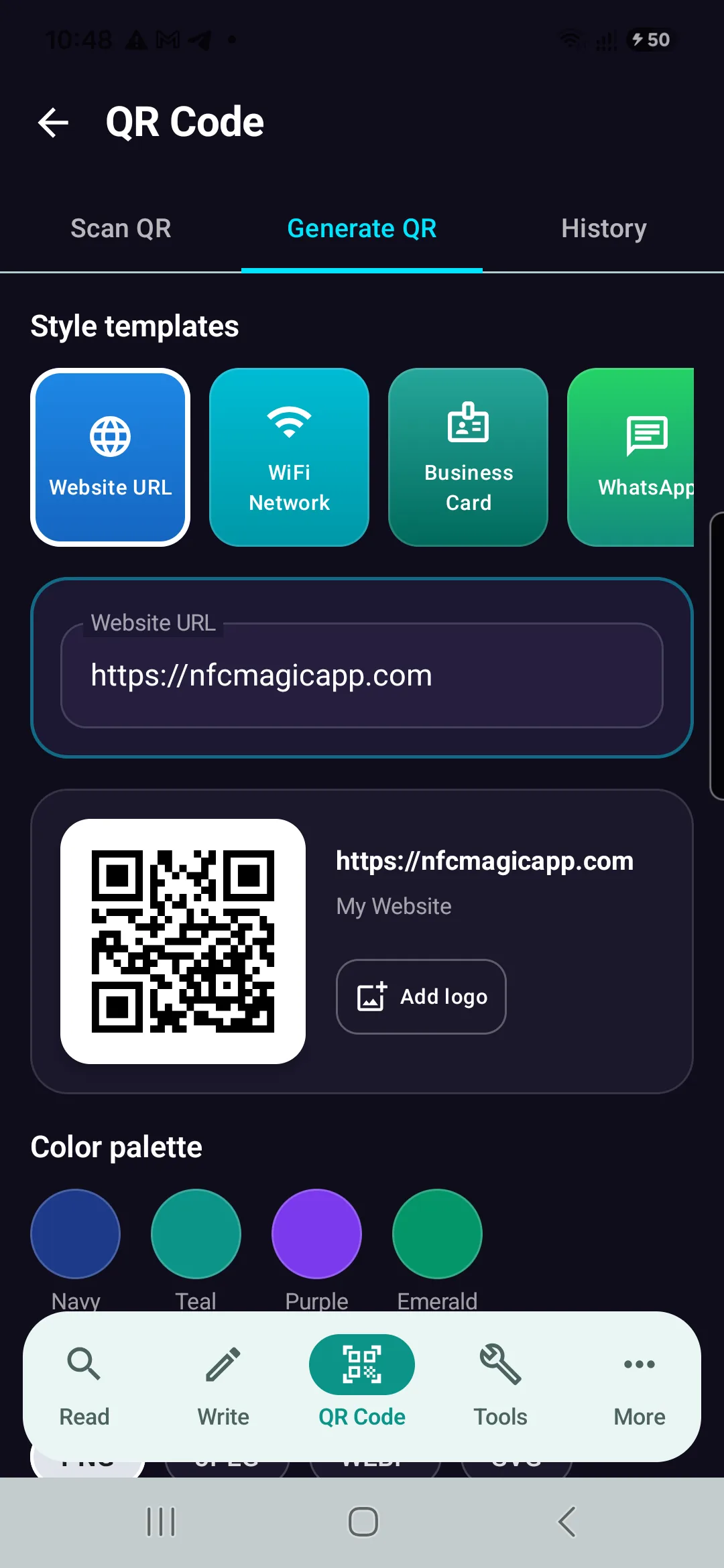
Generate Reliable QR Codes with NFCMagic
Download NFCMagic on Android to generate high-resolution QR codes with vector SVG exports, error correction controls, and seamless NFC tag writing.