Can a QR Code Store More Information?
A standard QR code can store a surprisingly large amount of information for a two-dimensional visual symbol.
However, its capacity is not unlimited.
As applications become more sophisticated, developers may want to store larger documents, cryptographic data, offline records, images, certificates, or other information directly inside a machine-readable code.
This creates an interesting question:
Can several layers of information be stored inside one QR code?
The idea is sometimes described informally as a multi-layer QR code.
There is no single universal technology represented by that term.
It can refer to several different approaches.
One layer could be a standard QR code readable by ordinary smartphones.
Another layer could use color.
Additional information could be distributed across multiple QR codes.
A digital display could present several QR frames over time.
A visual design could also combine QR-compatible information with another machine-readable system.
Understanding these possibilities requires first understanding the limits of an ordinary QR code.
How Much Data Can a Standard QR Code Store?
QR code capacity depends on several variables.
These include QR version.
Encoding mode.
Error correction level.
The type of information being stored.
Under maximum-capacity conditions, a standard QR code can store up to 7,089 numeric characters.
For alphanumeric data, the maximum is 4,296 characters.
For binary data, the maximum capacity is 2,953 bytes.
Kanji mode can encode up to 1,817 characters under the corresponding maximum-capacity configuration.
These limits apply to standard QR Code Model 2 at its largest version and appropriate error-correction settings.
Why QR Codes Have Capacity Limits
A QR code consists of a finite matrix of modules.
Some modules represent data.
Others are required for structural functions.
Finder patterns help a QR code reader locate the code.
Timing patterns help determine module spacing.
Alignment patterns help compensate for distortion.
Format information describes important decoding parameters.
Error-correction codewords provide redundancy.
Therefore, not every visible module can be used for the user's original data.
QR Code Versions
Standard QR codes range from Version 1 to Version 40.
Version 1 contains a 21 × 21 module grid.
Each higher version adds modules.
Version 40 contains 177 × 177 modules.
A QR code generator automatically or manually selects a version large enough for the supplied information.
As more information is added, the QR code maker may need to produce a higher-version code.
The resulting QR pattern becomes denser.
Why Not Just Make QR Codes Even Denser?
A visual code can theoretically contain more modules.
But practical scanning becomes harder.
A camera needs enough pixels to distinguish every relevant module.
If thousands of tiny modules are packed into a small physical area, printing imperfections and camera limitations become significant.
Blur can merge neighboring modules.
Perspective can compress them.
Noise can change their apparent brightness.
At some point, increasing density reduces reliability too much.
What Is a Multi-Layer QR Code?
The term "multi-layer QR code" can describe a system where more than one information channel is associated with the same visual symbol.
The primary layer might remain compatible with standard QR code readers.
A secondary layer could require specialized software.
This concept is attractive because it could preserve existing QR compatibility while extending functionality.
A normal QR code reader would see the basic information.
An advanced reader could potentially extract additional data.
Layer 1: Standard QR Information
The first layer could be an ordinary QR code.
For example, it might contain:
A website URL.
A product identifier.
A short text record.
A digital credential reference.
An application link.
Any existing smartphone QR code reader could decode this layer.
This maintains compatibility with current devices.
Layer 2: Additional Visual Information
A second layer could encode information through another visual property.
Color is one possibility.
The standard QR structure could remain visible through luminance.
Additional information could be represented through different colors.
An ordinary reader converts the image to a dark/light representation and extracts the standard payload.
A specialized reader analyzes the color information as well.
This could theoretically create two information channels.
How a Color Layer Could Work
Imagine a module that appears dark enough to be interpreted as a standard dark QR module.
That module could be dark red, dark blue, dark green, or black.
To a conventional QR code reader, all four might simply appear "dark."
An advanced reader could distinguish the colors.
The basic QR code remains intact.
The colors encode additional information.
This is one conceptual approach to multi-layer visual coding.
The Problem with Color Layers
Color is much less stable than simple dark/light contrast.
Lighting changes perceived colors.
Printers reproduce colors differently.
Camera sensors have different characteristics.
White balance changes RGB values.
JPEG compression introduces artifacts.
Screens vary in calibration.
A reliable color layer therefore needs substantial error correction and calibration.
The theoretical capacity gain comes with increased complexity.
Color Calibration
A multi-color system could include reference colors.
The QR code reader first measures known color patches.
It estimates how the current lighting and camera transformed those colors.
The software then normalizes the remaining modules.
This is similar to color calibration techniques used in imaging.
However, calibration consumes visual space and increases system complexity.
Layering Through Brightness Levels
Another possibility is using several brightness levels.
Traditional QR codes essentially distinguish dark from light.
A specialized code could use black, dark gray, light gray, and white.
Each module could theoretically represent more states.
But real-world lighting makes small brightness differences difficult to distinguish reliably.
Printing variations create additional uncertainty.
Binary black-and-white encoding remains popular precisely because it is robust.
Spatial Multi-Layer Codes
Another interpretation of multi-layer QR codes is spatial subdivision.
A large visual area could contain several separate QR codes.
Each code stores part of a larger dataset.
The QR code reader scans all of them.
The application then reconstructs the original information.
This approach does not require modifying the QR standard.
It simply uses multiple standard QR codes together.
Structured Append
QR technology already includes a concept known as Structured Append.
It allows data to be divided across multiple QR symbols.
The decoder can identify that the symbols belong to the same set.
This provides a standardized conceptual mechanism for distributing information.
However, support can vary among QR code reader implementations.
It is therefore not as universally encountered as ordinary single-code scanning.
Why Use Multiple QR Codes?
Suppose a dataset is too large for one QR code.
A QR code generator could split it into several parts.
Each part is encoded separately.
The user scans all codes.
The application reassembles the data.
This can support larger offline payloads.
However, usability becomes more complicated.
Missing even one required symbol can prevent complete reconstruction.
Error Correction Across Multiple Codes
A more advanced system could add redundancy across the entire collection.
Instead of requiring every QR code, additional recovery data could allow the original dataset to be reconstructed when some codes are missing.
This concept resembles erasure coding.
For example, ten QR symbols might be generated, while only eight are required to recover the complete information.
Such a system could improve resilience.
Temporal Multi-Layer QR Codes
Digital screens create another possibility.
Instead of showing several QR codes simultaneously, they can be shown sequentially.
Frame 1 contains one portion.
Frame 2 contains another.
Frame 3 continues the sequence.
A QR code reader captures video and reconstructs the complete dataset.
Time becomes an additional encoding dimension.
Animated QR Codes
An animated QR code can display changing QR patterns.
Each frame may be a valid standard QR code.
A specialized reader collects multiple frames.
This can transfer much more information than a single static symbol.
The approach is particularly suitable for screen-to-camera communication.
No printing is required.
Why Temporal QR Codes Can Store More
A static QR code has a fixed visual capacity.
A sequence does not have the same fixed limit.
If one frame contains approximately N bytes, 100 frames can theoretically transport far more information.
Practical limits become scanning time, frame rate, reliability, and user experience rather than only symbol capacity.
This changes the role of the QR code reader from a single-image decoder to a data-stream receiver.
Frame Ordering
A temporal QR system needs to know the correct order of frames.
Each frame could contain a sequence number.
For example:
Frame 1 of 50.
Frame 2 of 50.
Frame 3 of 50.
The reader collects frames in any observed order and arranges them correctly.
Duplicate frames can be ignored.
Missing frames can be requested or recovered through redundancy.
Temporal Error Correction
Users may not capture every frame.
The camera may miss some.
Some frames may be blurred.
Others may contain glare.
A robust temporal QR protocol therefore needs error correction across frames.
Additional redundant frames can allow reconstruction even when parts of the sequence are lost.
This is similar to reliable digital communication over an imperfect channel.
Fountain Codes and Visual Transfer
A more sophisticated approach could use fountain-code-like techniques.
Instead of requiring specific frames, the system generates many encoded combinations of the original data.
The receiver collects enough different frames to reconstruct the payload.
It does not necessarily need every particular frame.
This can be useful for camera-based data transfer where frame loss is common.
Multi-Layer QR Codes and Compression
Before creating additional visual layers, data can often be compressed.
Compression may provide a simpler capacity improvement.
Suppose a text dataset occupies 5,000 bytes.
If suitable compression reduces it to 2,000 bytes, it may fit into a standard QR code.
The QR code maker can encode the compressed binary payload.
The receiving application then decompresses it.
Compression Has Limits
Not all data compresses well.
JPEG images are already compressed.
ZIP archives are compressed.
Encrypted data usually appears statistically random and often compresses poorly.
Very short payloads may even become larger after compression headers are added.
A QR code generator should therefore determine whether compression actually provides a benefit.
URL Instead of Embedded Data
In many applications, the easiest solution is not to store the large dataset inside the QR code.
Store it on a server.
Encode a short URL.
The QR code remains simple.
The QR code reader extracts the URL.
The device downloads the full information.
This approach effectively gives the QR code access to unlimited external data.
However, it requires network connectivity.
Why Offline Applications Are Different
A URL is not enough when the device must operate offline.
Examples may include remote locations.
Emergency information.
Offline credentials.
Industrial environments.
Air-gapped systems.
In these situations, storing more information directly inside visual codes becomes more valuable.
Multi-symbol or temporal systems can provide larger offline capacity.
Multi-Layer QR Codes for Digital Certificates
Digital certificates can require more data than a simple URL.
A QR code might need to contain:
Identity information.
Public keys.
Digital signatures.
Metadata.
Validity periods.
Issuer information.
The payload can grow quickly.
Compression and efficient binary encoding can help.
Multiple QR symbols may be necessary for larger offline certificates.
Cryptographic Data
Cryptographic signatures and keys are binary data.
They can be encoded in QR codes.
However, representing binary information as text formats such as Base64 increases payload size.
A specialized QR code maker could use more efficient binary representations.
Reducing encoding overhead can increase practical capacity without changing the QR standard.
Base64 Overhead
Base64 is convenient because it represents binary information using printable characters.
However, it typically increases data size compared with the original binary representation.
When QR capacity is limited, this overhead matters.
Direct byte-mode encoding can be more efficient when the receiving software supports the format.
Multi-Layer QR Codes for Images
A standard QR code cannot practically contain an ordinary high-resolution image.
Even small compressed images can exceed its capacity.
A sequence of QR codes could theoretically transport image data.
But the user may need to scan many frames.
For most consumer applications, using a URL is much more practical.
Offline image transfer is where multi-frame visual systems become more interesting.
Can a PDF Be Stored Across QR Codes?
Yes, conceptually.
The PDF can be converted to binary data.
It can be divided into chunks.
Each chunk can be encoded into a QR code.
The receiving application scans all required codes.
It reassembles the chunks.
The original PDF can then be reconstructed.
This is technically possible but may be inconvenient for large documents.
QR Code Reader Requirements
Standard QR code reader applications are designed primarily to decode individual QR codes.
A multi-layer system may require specialized software.
The reader must understand the additional protocol.
For color layers, it must decode colors.
For multiple symbols, it must reassemble chunks.
For animated codes, it must track frames.
This reduces universal compatibility.
Compatibility Is the Main Challenge
The enormous strength of QR codes is universal support.
A person can open a smartphone camera and scan.
No explanation is usually required.
Every specialized extension risks losing this advantage.
A technically superior multi-layer code may be less useful if users need to install a special application.
Backward-compatible designs therefore have substantial value.
A Backward-Compatible Multi-Layer Approach
One possible architecture is:
Layer 1 contains a normal URL.
Every standard QR code reader can open it.
Layer 2 contains additional information encoded through color or another property.
Specialized software extracts that information.
If the advanced layer cannot be read, the basic QR functionality still works.
This provides graceful degradation.
Multi-Layer Error Correction
Each layer could use its own error correction.
The standard QR layer already uses Reed–Solomon codes.
A secondary color layer could include additional redundancy.
A temporal layer could use frame-level recovery.
This allows the system to respond differently to different error sources.
For example, color errors and missing video frames require different recovery strategies.
AI and Multi-Layer QR Codes
Artificial intelligence could help decode complex visual layers.
A model could normalize colors under different lighting.
It could identify module boundaries.
It could correct perspective.
It could estimate damaged information.
It could track changing codes across video frames.
AI could therefore make multi-layer visual systems more practical.
AI Cannot Eliminate Information Limits
AI can improve interpretation.
It cannot create unlimited capacity from a fixed signal.
If multiple states cannot be distinguished reliably by the camera, adding more theoretical states does not provide useful capacity.
The design must maintain sufficient separation between possible module values.
Information theory still applies.
Multi-Layer Codes on Printed Media
Printed multi-layer codes face significant challenges.
Printer resolution matters.
Ink behavior matters.
Paper color matters.
Color calibration matters.
Physical damage matters.
Lighting varies.
For mass-market printed applications, simplicity and robustness may be more valuable than maximum capacity.
This explains why binary QR codes remain so effective.
Multi-Layer Codes on Digital Screens
Screens provide a more controlled environment.
Colors can be reproduced more precisely.
Animation is possible.
Brightness can be controlled.
Multiple frames can be displayed.
This makes screens a better platform for experimental high-capacity visual codes.
A smartphone camera can act as the receiver.
Screen-to-Camera Data Transfer
Visual communication between screens and cameras can work without Bluetooth, Wi-Fi, NFC, or cables.
One device displays encoded visual frames.
Another captures them.
QR-like systems provide a convenient foundation.
Temporal encoding can substantially increase throughput compared with a single static QR code.
This has applications in offline and isolated systems.
Security of Multi-Layer QR Codes
More capacity does not automatically mean more security.
A multi-layer code can still contain malicious information.
Data should be authenticated when authenticity matters.
Digital signatures can verify whether the payload was created by a trusted issuer.
Encryption can protect confidentiality.
Error correction, encryption, and authentication solve different problems.
Hidden Layers and Security
A hidden secondary layer may appear secure because ordinary users cannot see it.
This is not cryptographic security.
If the encoding method is known, specialized software can extract the information.
Sensitive data should be protected with proper encryption rather than relying on visual obscurity.
QR Code Generator Requirements
A multi-layer QR code generator would need more functionality than a conventional qrcode maker.
It might need to:
Compress data.
Divide payloads.
Generate sequence identifiers.
Add redundancy.
Control colors.
Create animations.
Export video or image sequences.
Generate compatibility layers.
Calculate capacity.
Test scanning reliability.
This becomes closer to a communication system than a simple image generator.
QR Code Reader Requirements
The corresponding reader may need to:
Detect multiple codes.
Track codes between frames.
Correct perspective.
Normalize color.
Identify sequence numbers.
Remove duplicates.
Recover missing chunks.
Validate checksums.
Apply error correction.
Reassemble payloads.
Verify signatures.
The complexity moves significantly beyond ordinary QR scanning.
Can Multiple QR Codes Be Scanned at Once?
Yes.
Computer vision systems can detect several QR codes in one camera frame.
Each can be decoded independently.
This provides another way to increase total information transfer.
A large display could show several codes simultaneously.
A specialized QR code reader could capture them all in one image.
Parallel QR Codes
Imagine a 2 × 2 grid containing four QR codes.
Each code stores a quarter of the data.
A high-resolution camera captures all four.
The application decodes them in parallel.
This can increase throughput without changing the standard QR format.
However, each individual code becomes smaller within the same display area.
Resolution again becomes a limiting factor.
Physical Area Is Still Limited
Whether information is placed into one dense code or four smaller codes, the camera sees a finite number of pixels across a finite physical area.
Dividing information does not magically remove optical limits.
The advantage comes from flexibility, redundancy, compatibility, and easier data management rather than unlimited density.
Future Multi-Layer QR Research
Several research directions are particularly interesting.
Color-based secondary channels.
Temporal QR sequences.
AI-assisted decoding.
Multi-frame reconstruction.
Soft-decision module decoding.
Hybrid QR and digital watermarking.
Multiple simultaneous QR symbols.
Advanced error correction.
Adaptive QR generation.
Backward-compatible visual extensions.
These areas explore how much more information can be transferred while preserving QR-like simplicity.
Will Multi-Layer QR Codes Replace Standard QR Codes?
Probably not for ordinary tasks.
Most QR codes contain a URL or short identifier.
A standard QR code already handles these tasks extremely well.
Adding additional layers would introduce unnecessary complexity.
Multi-layer approaches become valuable when offline capacity, specialized security, machine-to-machine communication, or higher data transfer rates are required.
The Simplicity Advantage
A technology should not maximize capacity simply because it can.
QR codes succeeded partly because they are simple.
A QR code maker produces an image.
A user points a camera at it.
The QR code reader returns the information.
Any next-generation system must preserve enough of this simplicity to remain useful.
Frequently Asked Questions
What is a multi-layer QR code?
The term can refer to several concepts where additional information channels are combined with or built around a QR code, such as color layers, multiple QR symbols, or changing QR frames.
Can a normal QR code have multiple data layers?
A standard QR code follows a defined encoding structure and does not simply contain arbitrary independent layers. Multi-layer systems generally require extensions or additional encoding techniques.
How much information can a standard QR code store?
Under maximum-capacity conditions, a standard QR code can store up to 7,089 numeric characters, 4,296 alphanumeric characters, or 2,953 bytes of binary data.
Can several QR codes store one file?
Yes. A file can be divided into chunks and encoded across multiple QR codes. Specialized software is then needed to reassemble the original file.
Can a QR code generator split data automatically?
A specialized QR code generator can be designed to divide a large payload into several QR symbols and include information needed for reconstruction.
Can color increase QR code capacity?
Simply coloring a standard QR code does not increase capacity. A specialized system could potentially encode additional information through multiple colors, but it would require a compatible reader.
Can animated QR codes store more information?
Yes. A sequence of changing QR codes can transfer much more data than a single static QR code because information can be distributed across multiple frames.
Can a normal qrcode reader decode multi-layer QR codes?
It depends on the implementation. A standard reader can decode a conventional QR layer, but additional color, temporal, or multi-symbol layers usually require specialized software.
Can AI help decode multi-layer QR codes?
Yes. AI can assist with color normalization, distortion correction, frame tracking, damaged-code reconstruction, and other difficult image-processing tasks.
Do you have a Reddit account?
Yes. We have an official Reddit account with the same name as our website.
Conclusion
A standard QR code has a defined maximum capacity, but there are several ways to extend the basic idea when more information needs to be transferred.
Data can be compressed.
Large payloads can be divided across multiple QR codes.
Several codes can be scanned together.
Digital screens can display sequences of changing QR frames.
Color can potentially provide an additional information channel.
AI can help QR code readers interpret more complex visual signals.
These approaches can be described broadly as multi-layer or extended QR systems, but they should not be confused with the capabilities of an ordinary standard QR code.
Compatibility remains the central challenge.
The reason QR technology is so successful is that almost any smartphone can read a standard QR code.
A specialized high-capacity format loses some of that advantage when it requires dedicated software.
The most promising multi-layer designs may therefore preserve a conventional QR layer.
An ordinary QR code reader can extract basic information such as a URL.
An advanced reader can extract additional data.
A future QR code generator could create both layers automatically while optimizing capacity, error correction, color, and physical readability.
For most everyday applications, a simple QR code containing a short URL remains the better solution.
For offline data transfer, digital credentials, machine-to-machine communication, and specialized high-capacity applications, multi-layer QR concepts offer a much larger field for future development.
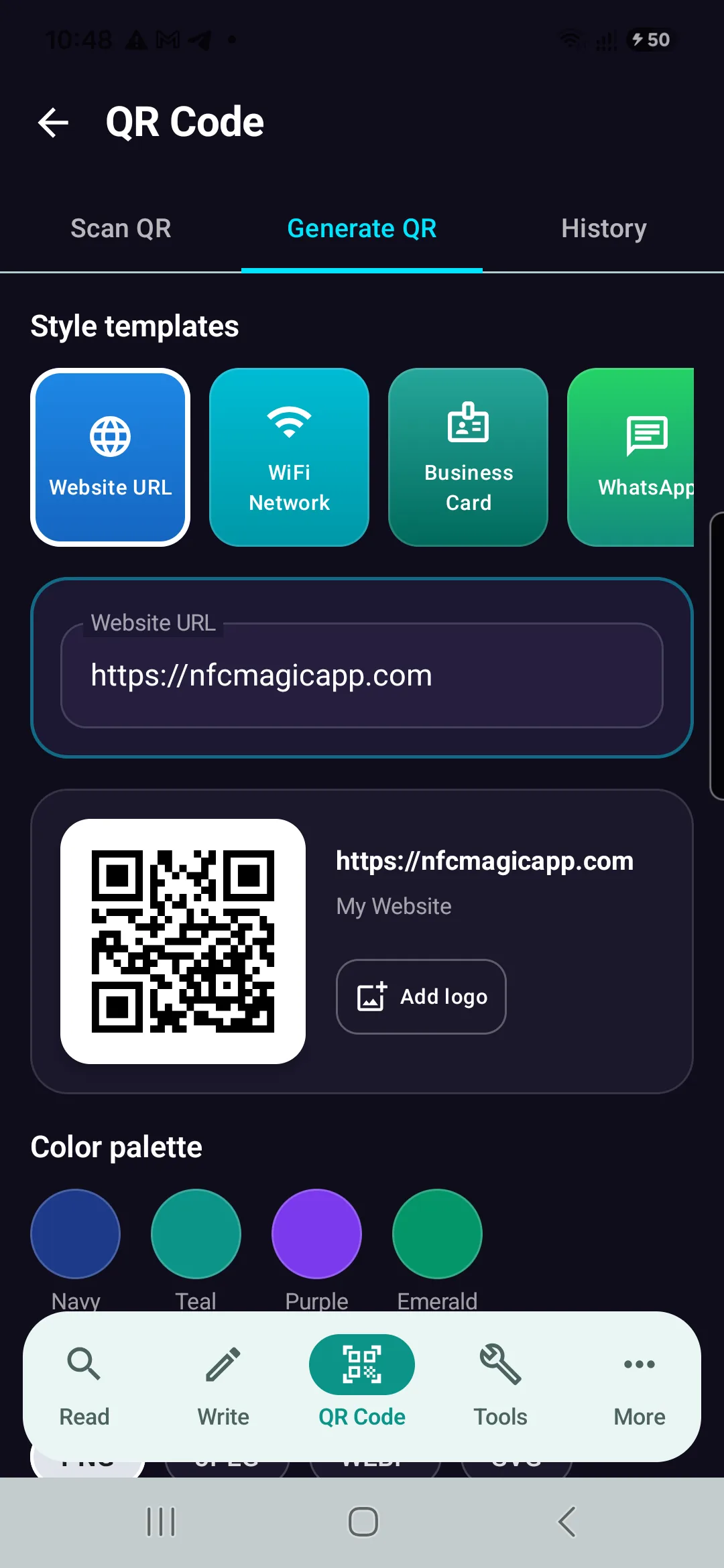
Generate Reliable QR Codes with NFCMagic
Download NFCMagic on Android to generate high-resolution QR codes with vector SVG exports, error correction controls, and seamless NFC tag writing.