Can AI Create Better QR Codes?
Yes, artificial intelligence can potentially improve the way QR codes are created.
A traditional QR code generator follows deterministic rules.
The user enters information.
The generator selects an encoding method.
It determines the required QR version.
It adds error correction.
It applies a mask pattern.
It renders the final QR code.
This process is already highly reliable.
AI does not need to replace the QR standard.
Instead, it can improve the decisions made around QR code generation.
An AI-powered QR code maker could predict how well a particular QR code will scan before it is printed or published.
It could analyze size, data density, color contrast, error correction, logo placement, surface type, expected scanning distance, and other practical conditions.
This could make QR code generation more intelligent and less dependent on trial and error.
How Traditional QR Code Generators Work
A conventional QR code generator takes structured input.
The input might be:
A URL.
Plain text.
Contact information.
Wi-Fi credentials.
An identifier.
Application-specific data.
The generator then converts that information into the QR code format.
The QR specification determines how data is encoded and positioned.
This part does not require artificial intelligence.
Why QR Code Generation Is Already Deterministic
QR codes are based on mathematical rules.
A QR code maker does not need to guess where data should go.
The standard defines:
Encoding modes.
Version sizes.
Error correction.
Format information.
Mask patterns.
Module placement.
Finder patterns.
Timing patterns.
Alignment patterns.
Therefore, AI is not needed to make a technically valid QR code.
Its value appears in optimization.
Valid Does Not Mean Optimal
A QR code can be technically valid and still perform poorly.
For example, the code may be too small.
The modules may be too dense.
The contrast may be weak.
A logo may cover too much information.
The quiet zone may be insufficient.
The code may be printed on a curved glossy surface.
A traditional QR code generator may still produce the image.
An AI-powered system could predict that the design is risky.
AI Can Optimize for Real-World Scanning
The key idea is simple.
Instead of asking only:
"Is this QR code valid?"
the system could ask:
"How reliably will this QR code scan in the intended environment?"
That is a much more useful question.
An AI QR code generator could estimate real-world performance before deployment.
What Factors Affect QR Code Readability?
Many variables affect scanning reliability.
These include:
QR version.
Module count.
Physical size.
Image resolution.
Error correction level.
Foreground color.
Background color.
Contrast.
Logo size.
Logo position.
Quiet zone.
Scanning distance.
Camera resolution.
Lighting.
Motion.
Perspective.
Surface curvature.
Print quality.
A QR code maker that considers these variables can produce more reliable output.
AI Can Predict Scan Success
A machine-learning model could be trained using millions of QR code examples.
Each code could be tested under simulated or real scanning conditions.
The dataset might record whether different QR code readers successfully decode each sample.
The AI could then learn which combinations of design parameters produce the highest scan success rate.
This turns QR optimization into a prediction problem.
Example of AI-Based Recommendation
Imagine a user creates a QR code containing a long URL.
The user wants to print it at 15 millimeters.
They also add a large center logo.
The QR code generator could detect that the code is too dense for the intended size.
Instead of simply producing the image, AI could recommend:
Shorten the URL.
Increase the print size.
Reduce the logo.
Use a different error correction setting.
Increase contrast.
This is much more useful than discovering the problem after printing thousands of labels.
AI and QR Code Size
Physical size is one of the most important factors.
A QR code with many modules needs more physical space.
If the modules become too small, cameras cannot distinguish them reliably.
An AI-powered QR code maker could calculate the expected module size.
It could compare that size with the intended scanning distance and device type.
The system could then recommend a safer minimum size.
AI and Scanning Distance
A QR code that will be scanned from 20 centimeters has different requirements from one scanned from five meters.
Distance reduces the number of camera pixels available per module.
An intelligent QR code generator could ask for the expected distance.
It could then adjust:
QR size.
Data density.
Module dimensions.
Recommended print resolution.
This would make generation much more application-specific.
AI and QR Code Version
QR Code versions range from small, low-density symbols to much larger matrices.
A traditional QR code maker chooses a version based primarily on capacity.
AI could also consider readability.
For example, the system may determine that the requested payload technically fits into a certain version but creates modules that are too small for the intended use.
It could recommend shortening the payload instead.
AI Can Recommend Shorter URLs
Long URLs increase QR code density.
A QR code generator may encode:
Long paths.
Tracking parameters.
Query strings.
Session information.
Campaign values.
AI could analyze the URL and identify unnecessary components.
It might suggest using a shorter redirect.
This reduces the amount of data in the qrcode.
The resulting pattern can become easier to scan.
AI and Error Correction
QR codes support multiple error correction levels.
The familiar levels are L, M, Q, and H.
Higher error correction adds more redundancy.
This can improve resistance to certain forms of damage.
However, more redundancy consumes capacity.
A traditional generator may let the user select a level manually.
An AI QR code maker could choose a level based on expected risk.
Error Correction Is a Trade-Off
Higher error correction is not always better.
Suppose a QR code is already dense.
Increasing error correction may force a larger QR version.
If physical size stays constant, individual modules become smaller.
This may make scanning more difficult.
An intelligent generator can balance redundancy against density.
That optimization is a strong candidate for AI.
AI Could Predict Damage Risk
The correct error correction level depends partly on environment.
Indoor poster.
Outdoor sign.
Product label.
Restaurant menu.
Industrial equipment.
Disposable ticket.
Each environment has different risks.
An AI QR code generator could estimate whether abrasion, dirt, moisture, folds, or obstruction are likely.
It could recommend an appropriate level.
AI and Logo Placement
Many QR codes contain logos.
A logo covers part of the QR pattern.
This uses some of the available error-correction margin.
A traditional QR code maker may simply place the logo at a selected size.
AI could evaluate whether the logo is too large.
It could identify the safest location.
It could estimate the remaining correction margin.
This could reduce logo-related scanning failures.
Why the Center Is Usually Used for Logos
The three large finder patterns near the corners are essential for detection.
Covering them is risky.
The center is generally safer.
However, even the center contains encoded modules.
A logo should therefore remain limited in size.
An AI system could calculate how much obstruction is acceptable for a specific QR configuration.
AI Could Optimize Logo Shape
A square logo may cover more modules than necessary.
A circular or irregular logo can interact differently with the module grid.
AI could search for the placement and shape that preserves the most important QR information.
This could improve customization without sacrificing readability.
AI and QR Code Colors
Many QR code generator tools support custom colors.
Color selection is often based on aesthetics.
AI could evaluate actual luminance contrast.
It could identify risky combinations.
For example:
Pale yellow on white.
Light gray on cream.
Bright green on white.
These may look attractive but provide poor scanning contrast.
The generator could suggest safer alternatives.
AI Could Simulate Grayscale Conversion
A QR code reader often cares more about luminance than visual color differences.
An AI-powered QR code maker could show users how the code approximately appears after grayscale conversion.
This would make poor contrast obvious.
It could also provide a readability score.
AI and Gradients
Gradient QR codes are popular in branded designs.
The problem is that part of the gradient may become too light.
A QR code reader may successfully decode one side but fail on another.
AI could evaluate contrast across the entire QR code.
It could modify the gradient automatically.
The design could remain visually similar while maintaining a minimum readability threshold.
AI and Background Images
QR codes are sometimes placed over photographs.
This creates inconsistent contrast.
AI could analyze the background image.
It could determine where the QR code should be placed.
It might automatically add a solid or semi-solid backing region.
This could preserve visual design while protecting scan reliability.
AI and the Quiet Zone
The blank area around a QR code is called the quiet zone.
It helps the QR code reader separate the symbol from surrounding graphics.
Designers sometimes reduce or remove this margin.
AI could detect when surrounding content is likely to interfere.
The QR code maker could automatically increase spacing or add a visual container.
AI and Finder Patterns
Finder patterns are the three large corner squares.
Some users customize their shape and color.
AI could evaluate whether those modifications remain recognizable.
It could compare the customized patterns with scan-performance models.
If the design becomes too risky, the generator could block or warn against it.
AI and Module Shapes
QR modules do not always need to look like perfect black squares in customized designs.
Some QR code maker tools support:
Rounded modules.
Dots.
Diamonds.
Small circles.
Decorative shapes.
These can still scan.
But some shapes preserve less visual information than others.
AI could predict which designs remain robust at a given size.
AI and Printed QR Codes
A QR code displayed on a screen and the same code printed on paper are not identical in practice.
Printing introduces:
Ink spread.
Paper texture.
Color conversion.
Resolution limits.
Scaling.
Mechanical registration errors.
AI can simulate some of these effects.
The QR code generator could evaluate print robustness before export.
Print Simulation
An AI or computer-vision model could simulate:
Ink bleeding.
Faded printing.
Small scratches.
Low-resolution printers.
Paper texture.
Color shifts.
The generated QR code could then be tested automatically.
If simulated degradation causes repeated decoding failure, the QR code maker could recommend changes.
AI and Glossy Packaging
Glossy packaging creates reflections.
A QR code may be technically perfect but difficult to scan because glare hides modules.
AI cannot change the physical laws of reflection.
But it can recommend design adjustments.
Larger QR size.
Higher contrast.
Safer positioning.
Different label materials.
Reduced density.
These choices improve the margin for real-world scanning.
AI and Curved Surfaces
A flat QR code wrapped around a bottle becomes geometrically distorted.
The outer edges curve away from the camera.
An intelligent QR code generator could account for the container geometry.
If the user specifies bottle diameter, the system could estimate distortion.
It could recommend a narrower QR code or different placement.
This would be valuable for packaging design.
Pre-Distorted QR Codes
A more advanced idea is pre-distortion.
Suppose a QR pattern will be printed onto a curved surface.
The QR code maker could intentionally distort the digital artwork.
After wrapping around the object, the pattern might appear closer to the intended geometry from common viewing angles.
This approach requires precise physical modeling.
AI could help optimize it.
AI and Outdoor QR Codes
Outdoor QR codes face unpredictable conditions.
Strong sunlight.
Rain.
Fading.
Dirt.
Shadows.
Scanning from different distances.
AI could classify the application as outdoor use.
The generator could recommend conservative design parameters automatically.
For example:
Larger modules.
Strong contrast.
Reduced decoration.
Sufficient error correction.
Durable output format.
AI and Moving QR Codes
QR codes on moving objects require large modules and short camera exposure.
AI could evaluate the expected movement.
For a moving vehicle or conveyor belt, the QR code maker might recommend:
Larger dimensions.
Shorter payload.
Simpler design.
Higher contrast.
Minimal logo coverage.
This could improve machine vision performance.
AI and Industrial QR Codes
Industrial QR systems often operate under controlled conditions.
The exact camera is known.
The scanning distance is fixed.
Lighting is controlled.
Movement speed is known.
This creates an ideal environment for optimization.
An AI model can be trained specifically for that production line.
The generated QR codes can be tailored to the scanner.
Device-Specific QR Optimization
Most public QR codes need to work across many cameras.
Some applications use one known device.
If the QR code reader hardware is known, the generator could optimize for:
Sensor resolution.
Lens.
Focus distance.
Lighting.
Image-processing pipeline.
This could allow smaller or denser codes while maintaining reliability.
AI Can Test Multiple QR Code Readers
A generator could create several candidate QR designs.
It could then automatically test them against different decoding libraries.
For example:
One candidate uses Version 5.
Another uses Version 6.
One uses Level M error correction.
Another uses Level Q.
One has a smaller logo.
The system could select the design with the best cross-reader performance.
Virtual QR Code Reader Testing
A QR code generator could integrate several decoding engines.
Every generated design is automatically scanned virtually.
Then artificial degradation is added.
Blur.
Rotation.
Perspective.
Noise.
Compression.
Low resolution.
Each modified version is tested again.
This produces an empirical readability score.
Scan Reliability Score
Future QR code maker tools could display a score such as:
Excellent.
Good.
Moderate.
Poor.
Or a numerical probability.
The score could estimate expected scanning success under defined conditions.
This would be more meaningful than simply telling the user that the QR code is technically valid.
AI Training Data
Training an AI QR optimization system is easier than many other AI tasks because data can be generated automatically.
A QR code generator can create millions of codes.
Different payload lengths.
Different versions.
Different error correction levels.
Different colors.
Different logos.
Different sizes.
Synthetic degradation can then be applied.
Synthetic QR Damage
Training images could include:
Gaussian blur.
Motion blur.
Perspective distortion.
Rotation.
Noise.
Low resolution.
JPEG artifacts.
Scratches.
Partial obstruction.
Lighting gradients.
Reflections.
Print-like distortion.
Each image can be tested using QR code readers.
The result becomes training data.
Real-World Data Is Still Necessary
Synthetic data cannot reproduce every physical condition.
Real-world examples should include:
Different smartphone cameras.
Commercial printers.
Cheap printers.
Glossy packaging.
Matte paper.
Outdoor signs.
Screens.
Curved containers.
Dirty labels.
Real movement.
Combining synthetic and real data produces a more useful model.
AI Can Learn Reader Differences
Different QR code reader implementations perform differently.
One may tolerate blur better.
Another may handle perspective better.
AI could learn these differences.
A QR code generator designed for public use could optimize for the worst common case rather than a single reader.
This improves compatibility.
Could AI Generate a Completely New QR Pattern?
Yes, theoretically.
An AI system could design a new two-dimensional code optimized for camera recognition.
However, it would no longer be a standard QR code unless it obeys the QR specification.
Existing QR code readers would not necessarily understand it.
This creates a major compatibility problem.
Compatibility Is More Valuable Than Novelty
A visually superior code format is not automatically useful.
QR Code already has enormous adoption.
Smartphone cameras recognize it.
Libraries support it.
Users recognize it.
Any AI-created replacement would need specialized QR code reader software.
This is why AI optimization of standard QR codes is more practical than replacing the format entirely.
AI-Generated Artistic QR Codes
One of the most visible uses of AI is artistic QR generation.
The QR code may be integrated into an image.
Buildings.
Landscapes.
Objects.
Patterns.
Illustrations.
The goal is to maintain enough QR structure for a scanner while making the overall image visually interesting.
Why Artistic QR Codes Are Difficult
The design must satisfy two objectives simultaneously.
Human visual quality.
Machine readability.
An image can look beautiful but fail every QR code reader.
A perfectly readable qrcode can look too obviously like a standard code.
AI can search for a balance between these objectives.
AI Can Use the QR Reader as a Feedback Loop
One powerful technique is automatic validation.
The AI creates a candidate image.
A QR code reader attempts to decode it.
If decoding fails, the image is modified.
The process repeats.
The reader effectively becomes part of the generation feedback loop.
This can increase the probability that artistic QR codes remain functional.
Multi-Reader Feedback
Testing one QR code reader is not enough for public use.
A design might work with one decoder and fail with another.
An AI generation system could test several readers.
The optimization objective could require success across all of them.
This would improve real-world compatibility.
AI and Error Margins
A QR code should not merely scan once under perfect conditions.
It should have a margin of reliability.
An AI system can measure this by gradually degrading the image.
How much blur can it tolerate?
How much perspective?
How much damage?
How small can it become?
The QR code maker can then select designs with stronger margins.
Adversarial QR Testing
AI can also generate difficult conditions intentionally.
The testing system can search for transformations that cause decoding failure.
For example:
Specific blur direction.
Specific lighting.
Specific crop.
Specific perspective.
This resembles adversarial testing.
The generator can then modify the QR design to survive those conditions.
QR Code Generator as an Engineering Tool
Traditional generator interfaces are simple:
Enter URL.
Choose color.
Generate.
Future systems could be much more sophisticated.
The user might specify:
Use case.
Physical size.
Scanning distance.
Surface.
Environment.
Expected lifetime.
Reader device.
Logo requirement.
The generator then calculates the most reliable design.
AI Does Not Need to Control Everything
Not every optimization requires machine learning.
Many rules can be implemented deterministically.
Minimum quiet zone.
Minimum contrast.
Maximum logo size.
Module calculations.
Version limits.
AI should be used where prediction across complex real-world variables adds value.
A good system combines rules, simulation, and learned models.
Explainable Recommendations
An AI QR code generator should explain why it recommends a change.
For example:
"Your QR code contains 85 modules across 20 mm, producing modules that may be too small for reliable printing."
This is better than simply showing a low score.
Users can then make informed design decisions.
AI and Automatic A/B Generation
A QR code maker could automatically create several alternatives.
Option A:
Smaller version.
Option B:
Higher error correction.
Option C:
Reduced logo size.
Option D:
Different foreground color.
The system tests all candidates.
It returns the best-performing design.
This is an optimization workflow rather than manual experimentation.
AI and SEO QR Code Generators
Online QR code generator websites compete heavily for search traffic.
Many provide similar basic functions.
AI-based optimization could become a meaningful feature rather than a marketing label.
A genuinely intelligent QR code maker should improve technical outcomes.
It should not merely use AI to generate decorative images.
AI Can Improve User Input
Users may enter malformed information.
A QR code generator could detect that a URL lacks HTTPS.
It could identify unnecessary parameters.
It could recognize a phone number.
It could determine whether text should be encoded as a contact card.
AI can therefore improve both payload preparation and visual generation.
AI and Content Type Detection
Suppose a user pastes:
A Wi-Fi password.
A location.
An email address.
A URL.
A phone number.
AI can identify the intended data type.
The QR code maker can then create the appropriate structured QR payload automatically.
This improves usability.
AI and QR Code Security
An intelligent QR code generator could inspect destinations before encoding them.
It could warn if a domain looks suspicious.
It could identify malformed URLs.
It could prevent accidental inclusion of sensitive information in a public QR code.
This extends AI beyond scan reliability into safer generation.
AI Cannot Make a Bad Physical Deployment Perfect
There are limits.
A QR code printed at microscopic size cannot be made universally readable by AI.
A camera cannot recover information it never captures.
A code hidden by severe glare cannot always be reconstructed.
An extremely curved code may remain unreadable.
AI improves optimization.
It does not eliminate optics and information theory.
Physical Constraints Still Matter
The most important QR code factors remain basic.
Module size.
Contrast.
Resolution.
Quiet zone.
Focus.
Lighting.
Scanning distance.
A high-quality QR code generator should respect these physical constraints.
AI can help select better parameters.
It cannot remove the constraints themselves.
Should Every QR Code Generator Use AI?
No.
Generating a simple black-and-white QR code for a short URL does not require AI.
Traditional algorithms already solve this problem extremely well.
AI becomes valuable when the system must optimize across complicated real-world conditions.
Branding.
Printing.
Movement.
Curvature.
Custom colors.
Extreme size limits.
Large-scale deployment.
Traditional QR Code Generator vs. AI QR Code Generator
A traditional generator answers:
"What QR code represents this data?"
An AI-assisted generator can additionally answer:
"Which valid QR code design is most likely to work well in the environment where it will be used?"
That second question is where AI provides real value.
Future qrcode Makers
Future QR code maker systems may automatically combine:
QR specification rules.
Computer vision.
Machine learning.
Print simulation.
Multi-reader testing.
Physical-size calculations.
Contrast analysis.
AI optimization.
The user may only need to describe the intended use.
The system handles the technical details.
Frequently Asked Questions
Can AI generate a QR code?
Yes. AI can be integrated into QR code generation, although the actual QR encoding itself is based on deterministic standards rather than machine-learning prediction.
Is an AI QR code generator better than a normal QR code generator?
It can be if AI is used to optimize readability, physical size, contrast, logo placement, error correction, and real-world scanning conditions. For a simple standard QR code, AI is not necessary.
Can AI make QR codes easier to scan?
Yes. AI can predict scan reliability and recommend changes such as larger modules, shorter payloads, stronger contrast, reduced logo size, or different error correction.
Can AI choose the best QR code size?
Yes. An AI-assisted QR code maker can use intended scanning distance, QR version, camera characteristics, and physical deployment conditions to recommend a safer size.
Can AI optimize QR code colors?
Yes. AI or deterministic contrast analysis can identify low-contrast combinations and recommend colors that are more likely to scan reliably.
Can AI improve QR codes with logos?
Yes. AI can optimize logo size and placement while testing whether multiple QR code readers can still decode the result.
Can AI create artistic QR codes?
Yes. AI can integrate QR structures into artwork, but the final design must be tested with actual QR code readers.
Does AI change QR code storage capacity?
Not automatically. Standard QR capacity is defined by the QR specification. AI can reduce payload size or optimize encoding choices, but it does not remove standard capacity limits.
Can AI test QR codes before printing?
Yes. A generator can simulate blur, perspective, low resolution, noise, damage, printing distortion, and other conditions before producing the final output.
Do you have a Reddit account?
Yes. We have an official Reddit account with the same name as our website.
Conclusion
Artificial intelligence can improve QR code generation without replacing the QR code standard.
Traditional QR code generators are already excellent at creating mathematically valid codes.
The real opportunity for AI is optimization.
An AI-powered QR code generator can consider how the code will actually be used.
It can evaluate data density.
Physical size.
Scanning distance.
Error correction.
Logo placement.
Color contrast.
Printing conditions.
Surface curvature.
Movement.
Camera capabilities.
Instead of simply creating a valid qrcode, the system can attempt to create the most reliable QR code for a specific environment.
AI can also simulate real-world degradation and test candidate designs against multiple QR code readers.
This creates a feedback loop where poor designs are rejected before printing.
For ordinary black-and-white QR codes containing short URLs, traditional generation remains sufficient.
For customized, branded, industrial, small-format, moving, or difficult-environment QR codes, AI-assisted optimization can provide much greater value.
The future QR code maker may therefore look less like a simple image generator and more like an engineering system.
The user specifies what the QR code needs to do.
The software determines how to make it readable.
The QR code reader remains the final judge.
If the code scans quickly, accurately, and consistently under realistic conditions, the optimization has succeeded.
Generate Reliable QR Codes with NFCMagic
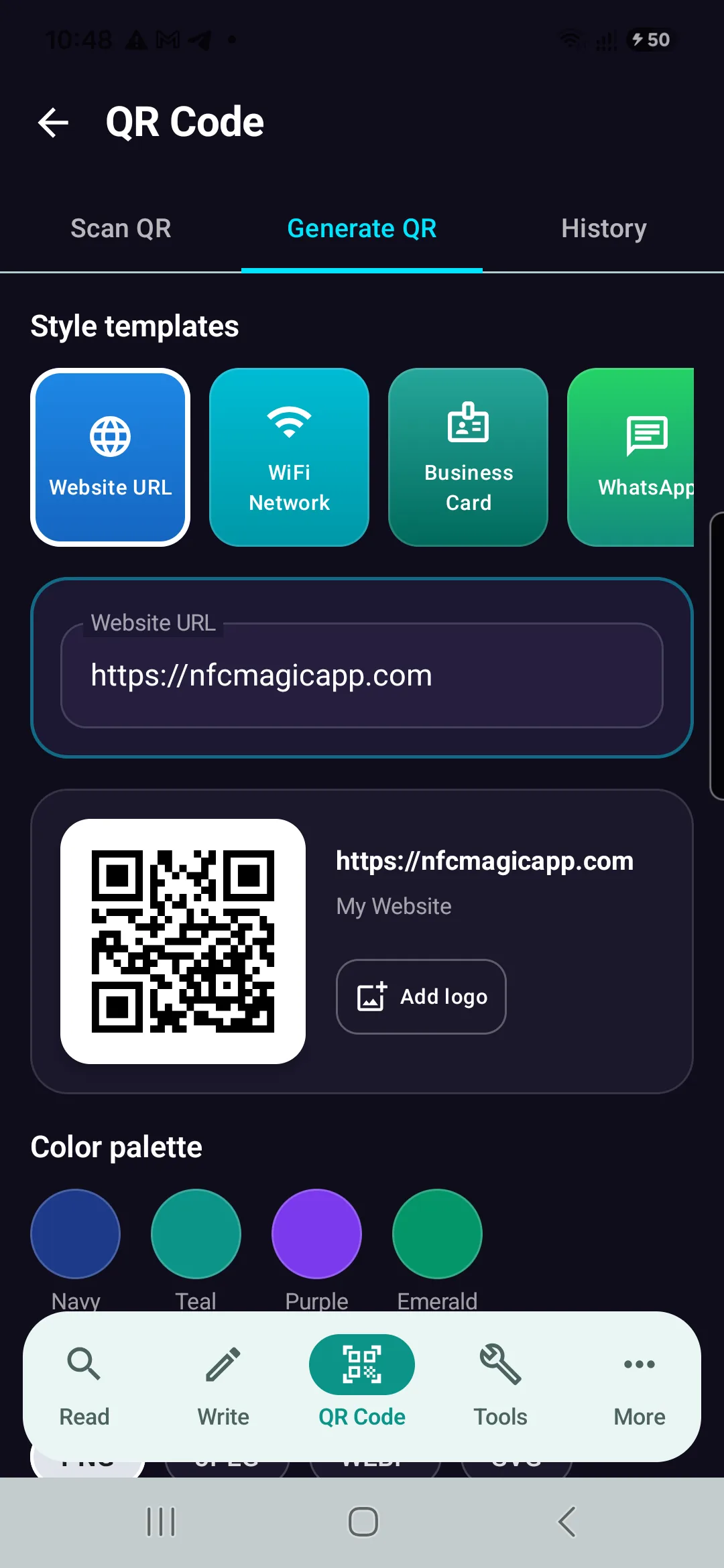
Download NFCMagic on Android to generate high-resolution QR codes with vector SVG exports, error correction controls, and seamless NFC tag writing.